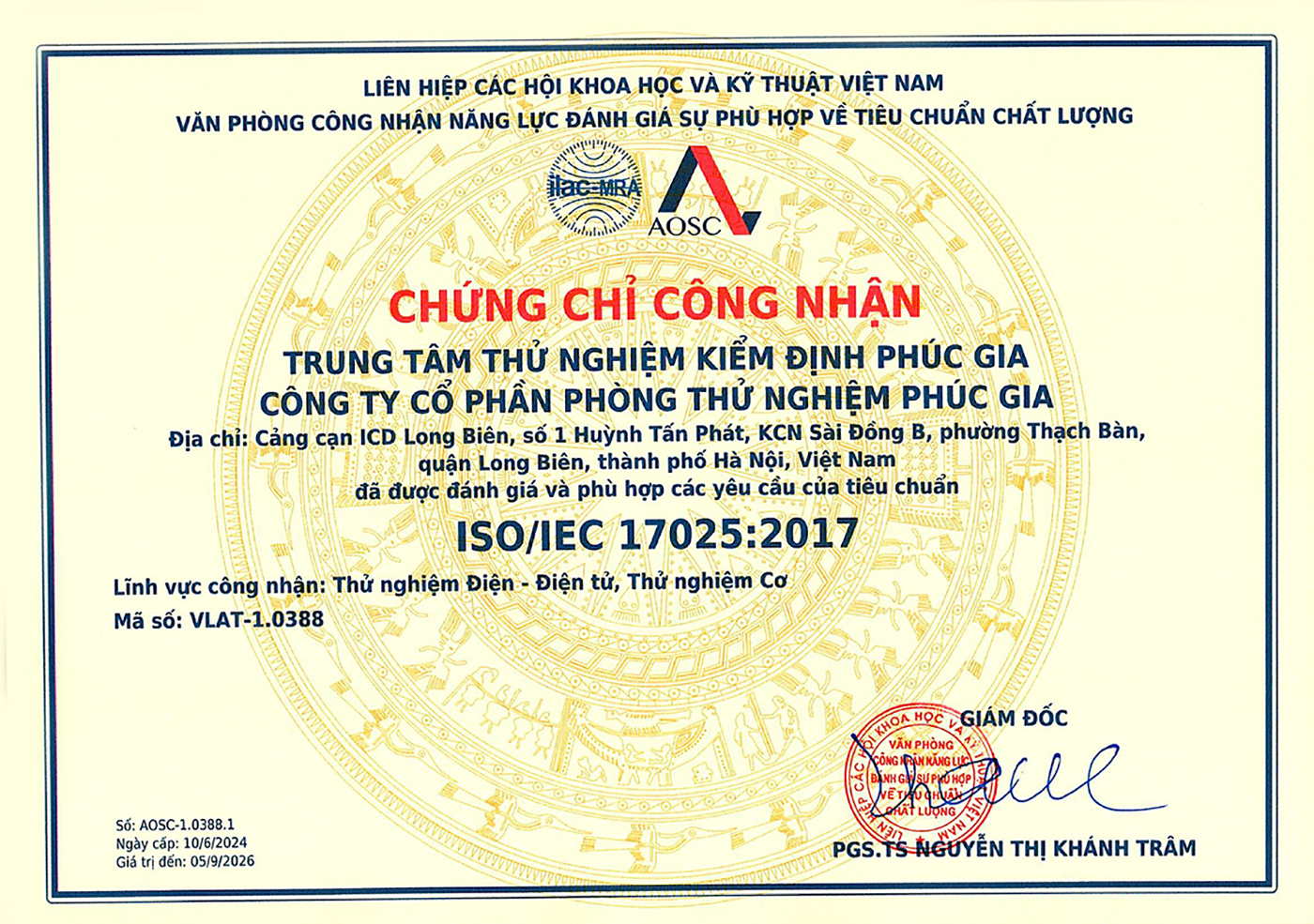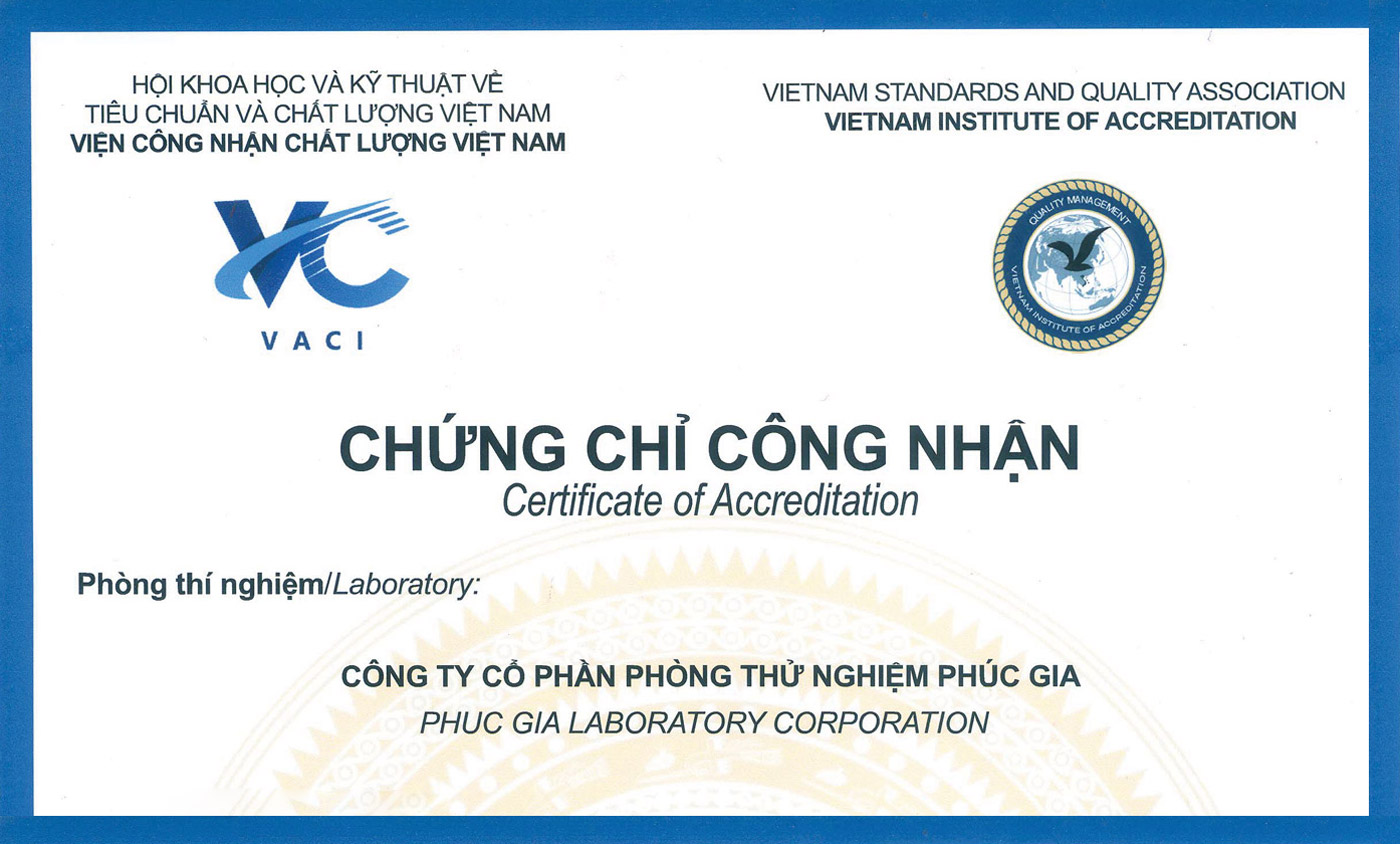


QCVN 25:2025/BKHCN is the technical regulation for electrical accessories used in household and similar fixed electrical installations, promulgated by the Ministry of Science and Technology under Circular No. 01/2025/TT-BKHCN dated February 14, 2025. This regulation applies to organizations and individuals manufacturing or trading electrical equipment, state management agencies, and other relevant organizations and individuals.
See more: Capacity Profile Of Phuc Gia Laboratory Corporation
I. Overview of QCVN 25:2025/BKHCN
QCVN 25:2025/BKHCN was drafted by the Drafting Committee for National Technical Regulations on electrical accessories for household and similar fixed electrical installations, submitted by the Commission for Standards, Metrology and Quality, and promulgated by the Ministry of Science and Technology under Circular No. 01/2025/TT-BKHCN with the following implementation roadmap:
- From April 1, 2025: Organizations and individuals manufacturing or trading electrical equipment are encouraged to voluntarily apply QCVN 25:2025/BKHCN.
- From April 1, 2027: All electrical equipment specified in Annex A and Annex B of QCVN 25:2025/BKHCN must comply (mandatory application) with the provisions of this regulation before being circulated on the market.
Accordingly, QCVN 25:2025/BKHCN stipulates safety and management requirements for electrical equipment used in household and similar electrical systems as listed in Annex A and Annex B of this National Technical Regulation (hereinafter referred to as the List of Electrical Equipment). The HS codes for electrical equipment in Annex A and Annex B are regulated in accordance with Circular No. 31/2022/TT-BTC dated June 9, 2022, of the Ministry of Finance.
The scope of this technical regulation only covers electrical equipment designed for installation in power distribution systems up to 440 V AC in civil engineering works.

QCVN 25:2025/BKHCN stipulates that domestically manufactured electrical equipment must be declared for conformity according to this regulation and bear the conformity mark (CR mark) before being circulated on the market. Imported electrical equipment must undergo state inspection for quality through the review of conformity declaration activities in accordance with this National Technical Regulation and bear the conformity mark before being circulated on the market.
The declaration of conformity for electrical equipment must be based on the results of a conformity assessment from a designated certification body. Accordingly, electrical equipment belonging to Annex A of QCVN 25:2025/BKHCN must apply Method 7 or Method 5 for conformity certification, while equipment in Annex B uses Method 1.
Note:
- The Certificate of Conformity according to Method 7 is only valid for each specific shipment.
- Certificates according to Method 1 or 5 have a maximum validity of 3 years from the date of issuance.
QCVN 25:2025/BKHCN encourages testing organizations to develop typical test report templates based on the IECEE Test Report Form. Typical test results must fully reflect the following contents:
- Full testing content according to the technical requirements of QCVN 25:2025/BKHCN
- Color photos of the exterior, interior, and product labels. The photos must show the shape, structure, component distribution, and details of components and parts important to the safety of the product
- A list of main components clearly showing the component name, model/type designation, technical specifications, certification marks printed on the component, and the conformity certificate number issued for this component (if any)
- Description of different details of product types within a product family and analysis of why the sample selected for testing is representative of the product family if type testing is conducted on a product family.
II. Full Text of QCVN 25:2025/BKHCN (Translation)
NATIONAL TECHNICAL REGULATION ON ELECTRICAL EQUIPMENT
FOR HOUSEHOLD ELECTRICAL INSTALLATIONS AND SIMILAR ELECTRICAL SYSTEMS
Foreword
QCVN 25:2025/BKHCN was drafted by the Drafting Committee for National Technical Regulations on electrical accessories for household and similar fixed electrical installations, submitted for approval by the Commission for Standards, Metrology and Quality, and promulgated under Circular No. 01/2025/TT-BKHCN dated February 14, 2025, by the Minister of Science and Technology.
1. GENERAL PROVISIONS
1.1. Scope of Regulation
This National Technical Regulation stipulates safety and management requirements for electrical accessories used in household and similar electrical installations as specified in the Lists in Annex A and Annex B of this National Technical Regulation (hereinafter referred to as the List of Electrical Equipment). The HS codes for electrical equipment in Annex A and Annex B are regulated in accordance with Circular No. 31/2022/TT-BTC dated June 8, 2022, of the Ministry of Finance, promulgating the Nomenclature of Exports and Imports of Vietnam.
The scope of this technical regulation only covers electrical equipment designed for installation in AC power distribution systems up to 440 V for civil works.
The following types of electrical equipment are excluded from the scope of this National Technical Regulation:
– Explosion-proof electrical equipment specified in the List of potentially unsafe products and goods under the management responsibility of the Ministry of Industry and Trade;
– Electrical sockets, plugs, socket adaptors, and cord extension sets with a rated current exceeding 32 A;
– Electrical switches with a rated current exceeding 20 A;
– Electrical switches designed for installation within electrical appliances;
– Circuit breakers (MCB/MCCB) with a rated current exceeding 63 A;
– Electrical equipment not within the scope of application of the corresponding standards mentioned in the List of Electrical Equipment.
1.2. Applicable Entities according to QCVN 25:2025/BKHCN
This National Technical Regulation applies to organizations and individuals manufacturing or trading electrical equipment, state management agencies, and other relevant organizations and individuals.
1.3. Interpretation of Terms
In this National Technical Regulation, the following terms are understood as follows:
1.3.1. Manufacturing and Trading Organizations/Individuals: Organizations or individuals engaged in the production, import, or sale of electrical equipment.
1.3.2. Designated Certification Body: A certification body designated in accordance with Decree No. 132/2008/ND-CP, as amended and supplemented by Decree No. 74/2018/ND-CP and Decree No. 154/2018/ND-CP.
1.3.3. Designated Testing Laboratory: A testing laboratory designated in accordance with Decree No. 132/2008/ND-CP, as amended and supplemented by Decree No. 74/2018/ND-CP and Decree No. 154/2018/ND-CP.
1.3.4. Conformity Assessment Method: Conformity assessment methods as prescribed in Circular No. 28/2012/TT-BKHCN dated December 12, 2012, of the Ministry of Science and Technology on regulations for Declaration of Conformity to standards, Declaration of Conformity to technical regulations, and methods for assessing conformity with standards and technical regulations.
1.3.5. Electrical Equipment: Equipment listed in the List of Electrical Equipment.
1.3.6. Electrical Accessories for Household and Similar Fixed Electrical Installations: Electrical equipment designed for installation in AC power distribution systems of civil works such as residential houses, shops, and public buildings.
1.3.7. IEC Test Report Form: A test result form according to IEC standards used in the systems of conformity assessment schemes for electrical and electronic equipment of the International Electrotechnical Commission (IECEE CB Scheme).
1.3.8. Model/Type: A string of characters assigned to a product to distinguish between products. Products of the same model/type have the same name, brand, design, construction, and technical features. Depending on the manufacturer’s regulations, products of the same model/type may sometimes differ in color or accessories.
1.3.9. Shipment/Batch: Products of the same model/type with a specific quantity belonging to the same import customs declaration for imported goods or the same conformity certification registration for domestically produced goods.
1.3.10. Product Family: Products of different models/types but having the same basic design. Determine the product family according to the guidance in Annex D.
1.3.11. Shipment Representative Sample: A sample randomly taken from a shipment to represent the entire shipment.
1.3.12. Product Family Representative Sample: A sample selected from a product family to represent the entire family. Determine the product family representative sample according to the guidance in Annex D.
1.3.13. Sample Testing: Testing on a shipment representative sample to serve as a basis for evaluating and certifying the shipment.
1.3.14. Type Testing: Testing on a product sample or a product family representative sample to determine that the product or product family fully complies with the technical requirements of this technical regulation.
1.3.15. IECEE: The IEC System of Conformity Assessment Schemes for Electrotechnical Equipment and Components.
1.3.16. IECEE Test Report Form: A test result form according to IEC standards drafted by a National Certification Body (NCB) and issued by IECEE.
2. TECHNICAL PROVISIONS ACCORDING TO QCVN 25:2025/BKHCN
2.1. Safety Requirements
Electrical equipment must comply with the corresponding standards specified in the List of Electrical Equipment.
2.2. Provisions on Climatic Conditions
For testing requirements related to climatic conditions, tropical climate conditions shall be applied.
3. MANAGEMENT REGULATIONS
3.1. Domestically produced electrical equipment must be declared for conformity according to this National Technical Regulation and bear the conformity mark before being circulated on the market.
3.2. Imported electrical equipment must undergo state inspection for quality through the review of conformity declaration activities in accordance with this National Technical Regulation and bear the conformity mark before being circulated on the market.
3.3. The Declaration of Conformity for electrical equipment must be based on the results of a conformity assessment from a designated certification body.
3.4. Conformity assessment Method 7 or Method 5 shall be used to perform conformity certification for electrical equipment specified in Annex A of this National Technical Regulation.
3.5. Conformity assessment Method 1 shall be used to perform conformity certification for electrical equipment specified in Annex B of this National Technical Regulation.
3.6. Validity of the Certificate of Conformity
The Certificate of Conformity according to Method 7 is only valid for the specific shipment that has been certified.
The Certificate of Conformity according to Method 1 or Method 5 remains valid for no more than 3 years from the date of issuance.
3.7. Provisions on Testing
3.7.1. Testing for conformity certification must be performed by a testing organization that is designated or recognized in accordance with Article 3.8 of this National Technical Regulation.
3.7.2. Testing organizations are encouraged to develop typical test report templates based on the IECEE Test Report Form. Typical test results must fully reflect the following contents:
– Full testing content according to the technical requirements of this National Technical Regulation;
– Color photos of the exterior, interior, and product labels. Photos must show the shape, structure, component distribution, and details of components and parts critical to the safety of the product;
– A list of main components clearly showing the component name, model/type designation, technical specifications, certification marks printed on the component, and the conformity certificate number issued for this component (if any);
– Description of different details of product types within a product family and an analysis of why the sample selected for testing is representative of the product family if type testing is conducted on a product family.
3.8. Principles for Recognition of Conformity Assessment Results
3.8.1. Certification bodies shall consider and recognize conformity assessment results provided by foreign conformity assessment bodies that have been recognized by Vietnam within the framework of mutual recognition agreements or arrangements that Vietnam has signed.
3.8.2. Certification bodies may sign agreements to recognize test results or utilize foreign testing laboratories that have the capacity to meet the technical requirements of this National Technical Regulation if those laboratories are accredited by accreditation bodies that are members of APAC or ILAC as conforming to ISO/IEC 17025 within the scope of recognition.
The signing of mutual recognition agreements must comply with the provisions in Circular No. 27/2007/TT-BKHCN dated October 31, 2007, of the Ministry of Science and Technology guiding the signing and implementation of Agreements and Arrangements for the mutual recognition of conformity assessment results.
3.8.3. Certification bodies may consider using test results from foreign testing organizations for certification purposes. These organizations must be accredited by APAC or ILAC members as conforming to ISO/IEC 17025. The scope of accreditation must include the standards and products specified in the test results used.
3.8.4. Certification bodies are permitted to consider recognizing and using test results according to newer versions of standards compared to the versions specified in the List of Electrical Equipment.
3.8.5. Recognized and used typical test results must comply with the provisions in Article 3.7.2. When recognizing or using typical test results, the certification body must review the results to ensure that the images, structure, and components of the certified product fully match those described in the typical test report.
3.8.6. Every quarter, certification bodies must submit reports on the recognition and use of conformity assessment results to the Commission for Standards, Metrology and Quality for monitoring and management. When necessary, the Commission will organize inspections of these activities.
3.8.7. When recognizing or using conformity assessment results from foreign organizations, the certification body shall be held responsible for such recognition and use.
4. RESPONSIBILITIES OF ORGANIZATIONS AND INDIVIDUALS
4.1. Responsibilities of Conformity Assessment Bodies
4.1.1. Perform conformity assessment in strict accordance with the provisions of this National Technical Regulation and fulfill reporting obligations regarding the results of conformity certification activities to the Commission for Standards, Metrology and Quality according to current regulations.
4.1.2. Must store conformity assessment records for at least ten (10) years from the expiry date of the certificate for Method 1 and Method 5, and from the date of certificate issuance for Method 7.
4.2. Responsibilities of Manufacturing and Trading Organizations and Individuals
4.2.1. Provide technical documents of electrical equipment to the certification body to facilitate type testing and conformity certification upon request.
4.2.2. Provide the certification body with information to be displayed on the certificate, such as the manufacturer’s name, manufacturer’s address, and the rated parameters of the product. The organization or individual providing the information shall be responsible for its accuracy.
4.2.3. Declare the standards applied to electrical equipment within the scope specified in Article 1.1.
4.2.4. Ensure that electrical equipment manufactured, imported, and circulated on the market has a structure, components, and quality consistent with the declared conformity dossier.
4.2.5. Notify the certification body of any design changes to products that have been certified.
4.2.6. Ensure that electrical equipment is declared for conformity and affixed with the conformity mark (CR) before being circulated on the market.
4.2.7. Recall electrical equipment already circulating on the market and be subject to penalties as prescribed by law if the goods are found to be non-compliant with the Technical Regulation or cause safety hazards due to faults of the manufacturer or trader.
4.2.8. Organizations and individuals performing the Declaration of Conformity must store the conformity declaration records and technical dossiers of the declared electrical equipment for at least ten (10) years from the date of declaration.
4.3. Responsibilities of State Management Agencies
The responsibilities of state management agencies are stipulated in Article 17 of Circular No. 28/2012/TT-BKHCN dated December 12, 2012; Clause 6, Article 1 of Circular No. 02/2017/TT-BKHCN dated March 31, 2017; and Article 14 of Circular No. 06/2020/TT-BKHCN dated December 10, 2020, of the Ministry of Science and Technology.
5. ORGANIZATION OF IMPLEMENTATION
5.1. The Commission for Standards, Metrology and Quality is responsible for guiding and inspecting the implementation of this National Technical Regulation.
5.2. In the event that the legal documents specified in this Technical Regulation are amended, supplemented, or replaced, the new documents shall apply.
In the event that the standards referenced in this National Technical Regulation are amended, supplemented, or replaced, the implementation shall follow the guidance of the Ministry of Science and Technology.
5.3. In the event that Vietnam participates in or signs bilateral or multilateral agreements, the provisions of those agreements shall prevail./.
ANNEX A
List of electrical equipment subject to conformity certification according to Method 5 or Method 7
| ORD | Product Name | Product Code (HS) | Applicable Standards |
| 1. | Circuit breakers for overcurrent protection for AC operation, for household and similar installations (MCB) with a rated current not exceeding 63 A | 85362011 85362012 85362013 85362091 85362099 |
TCVN 6434-1:2018 (IEC 60898-1:2015) |
| 2. | Residual current operated circuit breakers with integral overcurrent protection for household and similar purposes (RCBO) with a rated current not exceeding 63 A | 85365020 | TCVN 6951-1:2007 (IEC 61009-1:2003) |
Note: Short-circuit test parameters for MCBs and RCBOs are excluded.
ANNEX B
List of electrical equipment subject to conformity certification according to Method 1
| ORD | Product Name | Product Code (HS) | Applicable Standards |
| 1. |
Electrical socket-outlets for household use with a rated current not exceeding 32 A
|
85366992 85366999 |
TCVN 6188-1:2007 (IEC 60884-1:2002) TCVN 6188-2-3:2016 (IEC 60884-2-3:2006) TCVN 6188-2-6:2016 (IEC 60884-2-6:1997) |
| 2. |
Electrical plugs for household use with a rated current not exceeding 32 A
|
85366992 85366999 |
TCVN 6188-1:2007 (IEC 60884-1:2002) TCVN 6188-2-1:2008 (IEC 60884-2-1:2006) |
| 3. |
Socket-outlet adaptors for household use with a rated current not exceeding 32 A
|
85366992 85366999 |
TCVN 6188-1:2007 (IEC 60884-1:2002) TCVN 6188-2-5:2016 (IEC 60884-2-5:1995) |
| 4. |
Cord extension sets for household use with a rated current not exceeding 32 A
|
85369094 85369099 |
TCVN 6188-1:2007 (IEC 60884-1:2002) TCVN 6188-2-7:2016 (IEC 60884-2-7:2013) |
| 5. |
Electrical switches for household use with a rated current not exceeding 20 A
|
85365061 85365069 |
TCVN 6480-1:2008 (IEC 60669-1:2007) |
| 6. |
Residual current operated circuit breakers without integral overcurrent protection for household and similar purposes (RCCB) with a rated current not exceeding 63 A
|
85365020 | TCVN 6950-1:2007 (IEC 61008-1:2006) |
Note:Short-circuit condition testing parameters for RCCBs are excluded.
ANNEX C
GUIDELINES FOR CONFORMITY CERTIFICATION
C.1. Conformity Certification Process
The certification body must develop a certification process based on the requirements and guidelines of the following documents:
– Circular No. 28/2012/TT-BKHCN of the Ministry of Science and Technology on regulations for Declaration of Conformity to standards, Declaration of Conformity to technical regulations, and methods for assessing conformity with standards and technical regulations;
– Circular No. 02/2017/TT-BKHCN of the Ministry of Science and Technology amending and supplementing several articles of Circular No. 28/2012/TT-BKHCN;
– Circular No. 06/2020/TT-BKHCN of the Ministry of Science and Technology providing detailed regulations and measures for the implementation of several articles of Decree No. 132/2008/ND-CP, Decree No. 74/2018/ND-CP, Decree No. 154/2018/ND-CP, and Decree No. 119/2017/ND-CP;
– Standard TCVN ISO/IEC 17067:2015 Conformity assessment — Fundamentals of product certification and guidelines for product certification schemes, with schemes 1a, 1b, and 5 corresponding to methods 1, 7, and 5 according to Circular No. 28/2012/TT-BKHCN;
– Standard TCVN ISO/IEC TR 17026:2016 Conformity assessment — Example of a certification scheme for tangible products;
– Standard TCVN ISO 19011:2018 Guidelines for auditing management systems.
The certification process shall be inspected and reviewed by the Commission for Standards, Metrology and Quality when necessary.
C.2. Guidelines for Sampling and Testing
With the exception of tests performed by the manufacturer, the tests mentioned in the sections below must be performed by a testing organization designated or recognized in accordance with Article 3.8 of this National Technical Regulation.
C.2.1. General Regulations on Type Testing and Review of Type Test Results
Type testing is performed on a product sample or a product family representative sample.
Identify the product family and select the representative sample according to the instructions in Annex D.
Samples used for type testing must:
– Be representative of the product to be certified;
– Be made from parts and assembly components that have been approved for use in production;
– Be manufactured using production tools and assembled according to methods established for the certified products.
The number of type test samples must be sufficient to fully test all contents as prescribed by the applicable standard, and 01 sample of each product model must be retained.
In cases where the organization or individual requesting certification provides type test results performed by designated or recognized testing organizations, the certification body must review and evaluate whether the content of the results is complete and compliant with the applicable standard. The certification body must also review and evaluate the consistency between the product to be certified and the information regarding images, structure, and components specified in the type test results provided.
C.2.2. Testing in Method 1 Certification
Type testing for initial certification must include all testing contents as prescribed by the applicable standard, except for the short-circuit test for RCCBs.
In recertification cycles, if the review of the product sample shows that the product has not changed in structure or components, re-testing is not required.
If, during the validity period of the certificate, the certified enterprise notifies the certification body of changes in the structure or components of the certified product, or if the review of the product sample during recertification evaluation shows changes that could affect the test results of one or more contents specified in the applicable standard, the contents potentially affected by these changes must be re-tested.
C.2.3. Sampling and Testing in Method 5 Certification
C.2.3.1. Sampling and Type Testing
Type testing for initial certification must include all testing contents as prescribed by the applicable standard, except for the short-circuit test for MCBs and RCBOs.
In recertification cycles, it is only necessary to take sufficient samples to test the contents specified in Table C.1 and retain 01 sample for each product model.
When the production process evaluation results show changes in components, materials used in the product, or production technology and equipment that could affect the test results of one or more contents specified in the applicable standard (but not listed in Table C.1), the potentially affected contents must also be considered for testing during recertification.
Samples used for testing during recertification must be taken at the production site.
|
ORD |
Product Name |
Applicable Standard |
Testing Content for Recertification under Method 5 |
|
1 |
Circuit breakers for overcurrent protection for AC operation, for household and similar installations (MCB) with a rated current not exceeding 63 A |
TCVN 6434-1:2018 (IEC 60898-1:2015) |
– Durability of marking
– Dielectric properties and isolation capability – Temperature-rise – 28-day test – Tripping characteristic – Mechanical and electrical endurance |
|
2 |
Residual current operated circuit breakers with integral overcurrent protection for household and similar purposes (RCBO) with a rated current not exceeding 63 A |
TCVN 6951-1:2007 (IEC 61009-1:2003) |
– Durability of marking
– Dielectric properties – Temperature-rise – Operating characteristic (specifically for residual current action) – Mechanical and electrical endurance – Trip-free mechanism – Operation of the test device at the limits of rated voltage – Operation of the RCBO in case of failure of the line voltage – Limiting values of the non-operating current under overcurrent conditions – Resistance to unwanted tripping due to surge currents – Insulation resistance and dielectric strength against impulse voltages – Operation of the RCBO in case of earth fault currents with DC components – Ageing of electronic components |
Table C.1 – Testing criteria for re-certification according to Method 5
C.2.3.2. Sampling and testing for surveillance assessment
During a certification cycle, each product type must be sampled and tested at least once for surveillance assessment.
NOTE: In cases where a product family has been identified, at least 50% of the product types within a product family must be sampled and tested at least once for surveillance assessment during a certification cycle. In consecutive cycles, selection should be made to ensure surveillance sampling of all product types within the same product family.
Samples are taken at the manufacturing site or from the market.
The testing criteria for surveillance assessment are the sample testing criteria specified in Table C.2.
The quantity of samples taken for testing must be sufficient to test the surveillance testing criteria.
C.2.3.3. Testing by the manufacturer
In certification assessment according to Method 5, for products where the applied standards specify Sample tests and Routine tests, the manufacturer must implement the following regulations:
– Must have established procedures for periodic sampling to test the sample testing criteria;
– Must conduct full testing of all routine testing criteria on products leaving the factory.
NOTE: A routine test specified in the applied standard may be replaced by another test if it can be demonstrated that such test is equivalent to the specified routine test.
C.2.4. Sampling and testing for certification according to Method 7
A shipment is only concluded to be in conformity with the technical requirements of this technical regulation when:
– The type test results of the product comply with the requirements of the applied standard. Type testing must include all testing contents as prescribed by the applied standard. An exception is made for short-circuit testing for MCB and RCBO:
NOTE: Type test results may be the results of testing on samples taken from the shipment or type test results performed before the shipment was manufactured or imported. Type testing and the review/acceptance of type test results shall comply with the provisions in section C.2.1.
– The sample test results on representative samples of the shipment comply with the requirements of the applied standard.
The quantity of representative shipment samples and the sample testing criteria are specified in Table C.2.
|
ORD |
Product Name |
Applicable Standard |
Quantity of Representative Shipment Samples (a) |
Sample Testing/Surveillance Criteria |
|
1 |
Circuit-breakers for overcurrent protection for alternating current, for household and similar installations (MCB) with a rated current not exceeding 63 A |
TCVN 6434-1:2018 (IEC 60898-1:2015) |
Take 03 samples for every 2000 products |
– Dielectric properties and isolation capability
– Tripping characteristics |
|
2 |
Residual current operated circuit-breakers with integral overcurrent protection for household and similar purposes (RCBO) with a rated current not exceeding 63 A |
TCVN 6951-1:2007 (IEC 61009-1:2003) |
Take 03 samples for every 2000 products |
– Dielectric properties – Operating characteristics |
NOTE: For shipments with a quantity greater than 2,000 products, the shipment shall be divided into smaller lots, each with a quantity of 2,000 products or fewer, for sampling purposes.
Table C.2 – Quantity of representative shipment samples and sample testing criteria
In the event that the type test results on samples taken from the shipment do not comply with the applied standard, the certification body may take additional samples and re-test to exclude cases where a sample of poor quality was randomly selected for type testing.
In cases where an imported shipment has a small quantity (15 units per model or fewer), and the importing enterprise/individual provides a written commitment to use the products internally, not for sale on the market, and assumes all responsibilities related to product safety according to QCVN 25:2025/BKHCN for the imported products, the certification body may only test the criteria specified in Table C.3 on 01 sample taken from the shipment to assess the shipment’s conformity with QCVN 25:2025/BKHCN without needing to review the conformity of the type test results.
|
ORD |
Product Name |
Applicable Standard |
Testing Criteria |
|
1. |
Circuit-breakers for overcurrent protection for alternating current, for household and similar installations (MCB) with a rated current not exceeding 63 A
|
TCVN 6434-1:2018 (IEC 60898-1:2015) |
– Dielectric properties and isolation capability
– Tripping characteristics |
|
2. |
Residual current operated circuit-breakers with integral overcurrent protection for household and similar purposes (RCBO) with a rated current not exceeding 63 A
|
TCVN 6951-1:2007 (IEC 61009-1:2003) |
– Dielectric properties
– Operating characteristics |
|
3. |
Electrical socket-outlets for household use with a rated current not exceeding 32 A
|
TCVN 6188-1:2007 (IEC 60884-1:2002) TCVN 6188-2-3:2016 (IEC 60884-2-3:2006) TCVN 6188-2-6:2016 (IEC 60884-2-6:1997) |
– Marking
– Protection against electric shock – Earthing requirements – Terminals and terminations – Insulation resistance and electric strength (at ambient temperature (20 ± 5) °C) – Temperature rise |
|
4. |
Electrical plugs for household use with a rated current not exceeding 32 A
|
TCVN 6188-1:2007 (IEC 60884-1:2002) TCVN 6188-2-1:2008 (IEC 60884-2-1:2006) |
– Marking
– Protection against electric shock – Earthing requirements – Terminals and terminations – Insulation resistance and electric strength (at ambient temperature (20 ± 5) °C) – Temperature rise |
|
5. |
Socket-outlet adaptors for household use with a rated current not exceeding 32 A
|
TCVN 6188-1:2007 (IEC 60884-1:2002) TCVN 6188-2-5:2016 (IEC 60884-2-5:1995) |
– Marking
– Protection against electric shock – Earthing requirements – Insulation resistance and electric strength (at ambient temperature (20 ± 5) °C) – Temperature rise |
|
6. |
Cord extension sets for household use with a rated current not exceeding 32 A
|
TCVN 6188-1:2007 (IEC 60884-1:2002) TCVN 6188-2–7:2016 (IEC 60884-2-7:2013) |
Electrical plugs are tested for criteria according to item 4 of this table.
Electrical socket-outlets are tested for criteria according to item 3 of this table. Cables must comply with the provisions in Clause 14.2 of TCVN 6188-2-7 and must have DC resistance and insulation thickness in accordance with the corresponding parts of TCVN 6610 or TCVN 9615 for the cable type. |
|
7. |
Electrical switches for household use with a rated current not exceeding 20 A
|
TCVN 6480-1:2008 (IEC 60669-1:2007) |
– Marking
– Protection against electric shock – Terminals – Insulation resistance and electric strength (at ambient temperature (20 ± 5) °C) – Temperature rise – Making and breaking capacity |
|
8. |
Residual current operated circuit breakers without integral overcurrent protection for household and similar purposes (RCCB) with a rated current not exceeding 63 A
|
TCVN 6950-1:2007 (IEC 61008-1:2006) |
– Dielectric properties
– Operating characteristics |
Table C.3 – Testing criteria applicable to small-quantity imports
In the event that the sample test results of the representative shipment samples do not comply with the applied standard, a second sampling is permitted with a sample quantity double that of the first sampling. The shipment shall only be assessed as conforming to the technical requirements of the regulation when the sample test results on all samples taken in the second sampling comply with the applied standard.
C.3. Certification records
The certification body must establish certification records to demonstrate that the product certification process has been carried out in accordance with the guidance of Circular No. 28/2012/TT-BKHCN and TCVN ISO/IEC TR 17026:2016.
The certification body must store the technical documentation of the certified product, including the following contents:
– Technical documents including a description of the product’s technical characteristics; circuit diagrams; a list of main components and parts; user manual; product installation instructions;
– Color photographs of the exterior, interior, and the product label. The photographs must show the shape, structure, component distribution, and details of components and parts critical to product safety. The certification body may coordinate with the testing organization to obtain product photographs from the testing organization without having to re-photograph the product.
– A list of main components clearly showing the component name, model/type designation, technical specifications, certification marks printed on the component, and the conformity certificate number issued for such component (if any);
– A detailed description table of the differences between product types within a product family and an analysis of why the sample selected for type testing represents the product family, if the assessment is conducted on a product family;
– Type test results of the product or product family;
– For certification assessment according to Method 7, the technical documentation must additionally include the test results on representative shipment samples and the results of the assessment of conformity between the samples taken from the shipment and the type-tested samples.
– For certification assessment according to Method 5, the technical documentation must additionally include test results from surveillance and re-certification;
If existing test results are recognized and used prior to the certification assessment, the technical documentation must include the results of the assessment of conformity between the certified product sample and the technical characteristic descriptions, images, structure, and the list of main components shown in the recognized and used type test results.
C.4. Post-certification surveillance
During the validity period of the certificate according to Method 5, the certification body must conduct periodic surveillance assessments at a frequency of no more than once every 12 months, or unscheduled surveillance assessments when there are complaints or when quality issues are detected in goods on the market.
During the validity period of the certificate according to Method 1, when there are complaints or when quality issues are detected in goods on the market, the certification body must conduct an unscheduled surveillance assessment by taking samples at the warehouse of the manufacturing or trading organization/individual or by taking samples from the market and re-testing these samples to reach a conclusion regarding the quality of the certified product.
C.5. Suspension, cancellation of validity, and withdrawal of Certificates
In cases where there is evidence of product non-conformity through periodic or unscheduled surveillance assessments, or if the organization/individual requesting regulation conformity certification fails to fully perform the obligations specified in Clause 2, Article 49 of the Law on Standards and Technical Regulations, the certification body shall, depending on the severity of the violation, implement appropriate handling measures such as suspending the certificate for a period not exceeding 3 months or canceling the validity and withdrawing the Certificate.
Upon suspension, the violating organization/individual must stop releasing the suspended products to the market, implement appropriate measures for non-conforming products already in circulation, and rectify the violations. If the suspension period expires and the violating organization/individual has not completed the rectification of the violations, the certification body shall consider implementing the measure of canceling the validity and withdrawing the Certificate.
When the validity is canceled and the Certificate is withdrawn, the violating organization/individual must stop releasing the products whose Certificate has been withdrawn to the market and must implement appropriate measures for all non-conforming products already in circulation.
C.6. Handling of shipments not conforming to technical regulations
In the event that testing and assessment results show that the product or imported shipment does not conform to the technical regulation and the organization/individual requesting certification cannot rectify these non-conformities, the certification body shall issue a notice of non-conformity to the requesting organization/individual, and simultaneously to the relevant state management agencies for coordinated surveillance and handling, and report to the Commission for the Standards, Metrology and Quality of Vietnam as regulated.
In cases where test results according to the standard versions listed in the List of Electrical Equipment are non-conforming but are conforming when tested according to newer standard versions, the test results according to the newer standard versions shall be accepted as the basis for regulation conformity certification.
ANNEX D
GUIDANCE ON PRODUCT FAMILIES AND SELECTION OF REPRESENTATIVE SAMPLES FOR PRODUCT FAMILIES
D.1. Reference documents
This guidance is developed based on the IECEE OD-2041 Ed 2.0 – Guide on Product Families, Family Ranges or Series of Products.
D.2. Definition of product families
To reduce testing costs and time, product types with the same characteristics are grouped into the same product family, and type testing is only conducted on one or a few product types to represent the entire product family.
The definition of a product family is as follows:
All product types within the same product family share the same design, structure, components, or essential parts to ensure compliance with the requirements of the standard.
The factors that may affect product safety are the same across all product types within the same family.
Depending on the product category, product types in the same family may have certain differences such as size, color, external shape, and may also differ in electrical parameters such as rated current, operating current, etc.; however, the nature of these differences does not alter the impact on safety of one product type compared to others in the same family.
If the standard applied to the product already provides guidance for determining the product family, the product family shall be determined according to that applied standard’s guidance.
For electrical installation equipment, manufacturers usually categorize product types by product family. The following suggestions are referenced to determine a product family.
D.2.1. Electrical switches
– Shared rated current, contact structure, contact base, and actuating member.
D.2.2. Plugs and socket-outlets
– Shared rated current, structure of electrical contact parts, and base of electrical contact parts.
D.2.3. Socket-outlet adaptors, cord extension sets
– Refer to D.2.2;
– Shared type and cross-sectional area of the connection cord.
D.2.4. MCB, RCBO, RCCB
– MCB according to Annex C – TCVN 6434-1:2018
– RCBO according to Annex A – TCVN 6951-1:2007
– RCCB according to Annex A – TCVN 6950-1:2007
D.3. Selection of representative samples for product families
The product type or group of product types selected to represent a product family must be those with the highest probability of non-conformity with the requirements of the standard.
Some examples of representative sample selection:
|
ORD |
Product |
Choose the representative for the product families |
|
5 |
Socket-outlets, plugs, socket-outlet adaptors, cord extension sets | Types with the maximum configuration. Priority is given to common types with higher production volumes than others |
|
6 |
MCB, RCBO, RCCB | According to the guidance of the applied standard |
ANNEX E
SAMPLE REGULATION CONFORMITY CERTIFICATE
ACCORDING TO METHOD 1 OR METHOD 5

Note: The certification body may change the layout of the Certificate from the template mentioned above, but the content of the Certificate must fully represent all information as prescribed in the template mentioned above.
ANNEX F
SAMPLE REGULATION CONFORMITY CERTIFICATE
ACCORDING TO METHOD 1 OR METHOD 7

Note: The certification body may change the layout of the Certificate from the template mentioned above, but the content of the Certificate must fully represent all information as prescribed in the template mentioned above.
ANNEX G
CONFORMITY MARK
G.1. Shape, dimensions, and presentation of the conformity mark
The shape, dimensions, and presentation of the conformity mark (CR mark) are specified in Circular No. 28/2012/TT-BKHCN and Circular No. 02/2017/TT-BKHCN.
G.2. Regulations on information displayed on the conformity mark
G.2.1. Conformity mark for certification according to Method 1 or Method 5
The conformity mark and the information displayed on the conformity mark are as follows:

Where:
ABC: Name of the certification body (state the Vietnamese or foreign abbreviated name of the certification body using an appropriate font and size).
XYZ: Certification number issued by the certification body to the certified enterprise/individual.
G.2.2. Conformity mark for certification according to Method 7
The conformity mark and the information displayed on the conformity mark are as follows:

Where:
ABC: Name of the certification body (state the Vietnamese or foreign abbreviated name of the certification body using an appropriate font and size).
Download QCVN 25:2025/BKHCN here
Please wait a few seconds to load the QCVN 25:2025/BKHCN on electrical equipment for household and similar electrical installations
RELATED POSTS
- Phuc Gia Testing and Inspection Center – Standard ISO/IEC 17025:2017 – VILAS 1212
- Phuc Gia Testing and Inspection Center – Standard ISO/IEC 17025:2017 – VALAS 009
- Phuc Gia Testing and Inspection Center – Standard ISO/IEC 17025:2017 – VLAT-1.0388 – Year 2024
- Draft TCVN on Plugs, Socket-outlets, Vehicle Connectors, and Vehicle Inlets – Conductive Charging for Electric Vehicles
For more details, please contact us at:
PHUC GIA LABORATORY CORPORATION
PHUC GIA CERTIFICATION CENTER
PHUC GIA INSPECTION TESTING CENTER
Hotline: 0965996696 / 0982996696 / 02477796696
E-mail: lab@phucgia.com.vn
Website: phucgia.com.vn
Working time: Monday to Friday 8:00 – 18:30; Saturday 8:00 – 12:00

![QUOTATION – Testing and Other Certification Services [2026]](https://phucgia.com.vn/wp-content/uploads/2017/03/bao-gia-thu-nghiem-chung-nhan.png)