


Ceiling fans are widely used electronic devices in households for their cooling function. However, today, ceiling fans are not merely used for cooling but also serve as decorative fixtures in homes, coming in a variety of designs. Although they are a widely popular appliance, how much do you really know about the Structure and Operating Principle of a Ceiling Fan? In this article, we invite you to join Phuc Gia® to explore this topic!
See more: Capacity Profile Of Phuc Gia Laboratory Corporation


The Size of a Ceiling Fan
Structure of a Ceiling Fan
Electric Motor: This is the component that generates the rotational movement for the fan. There are typically two main types: the capacitor-type motor and the shaded-pole motor. The motor is protected by being encased within the fan housing (canopy/body).
Fan Blades: These components are used to generate airflow (wind). They are typically made from materials such as plastic, alloy, wood, fiberglass, etc., and come in various colors. To meet the diverse demands of customers, manufacturers also produce ceiling fans with varying numbers of blades, which can be 3, 4, 5, or even 8 or 10 blades. The ceiling fan blades are attached to the fan housing using screws and mounting brackets.
Speed Regulator (Gearbox/Controller): This component is used to adjust the fan’s wind speed. Ceiling fans can have anywhere from 3 to 9 different speed levels.
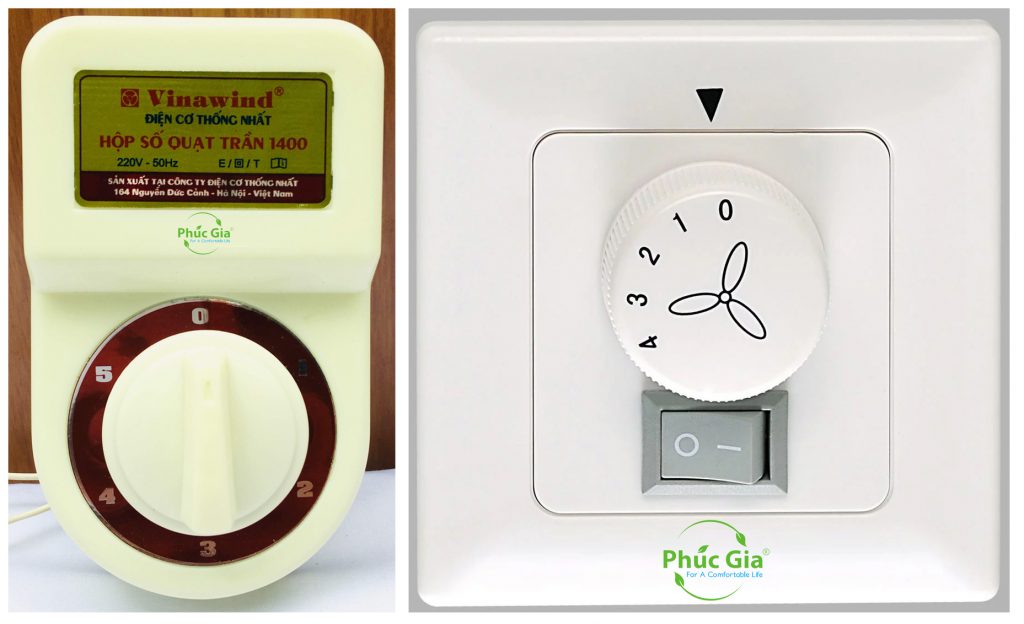
The ceiling fan speed controller is used to change the fan’s rotation speed based on the controller’s settings (positions).
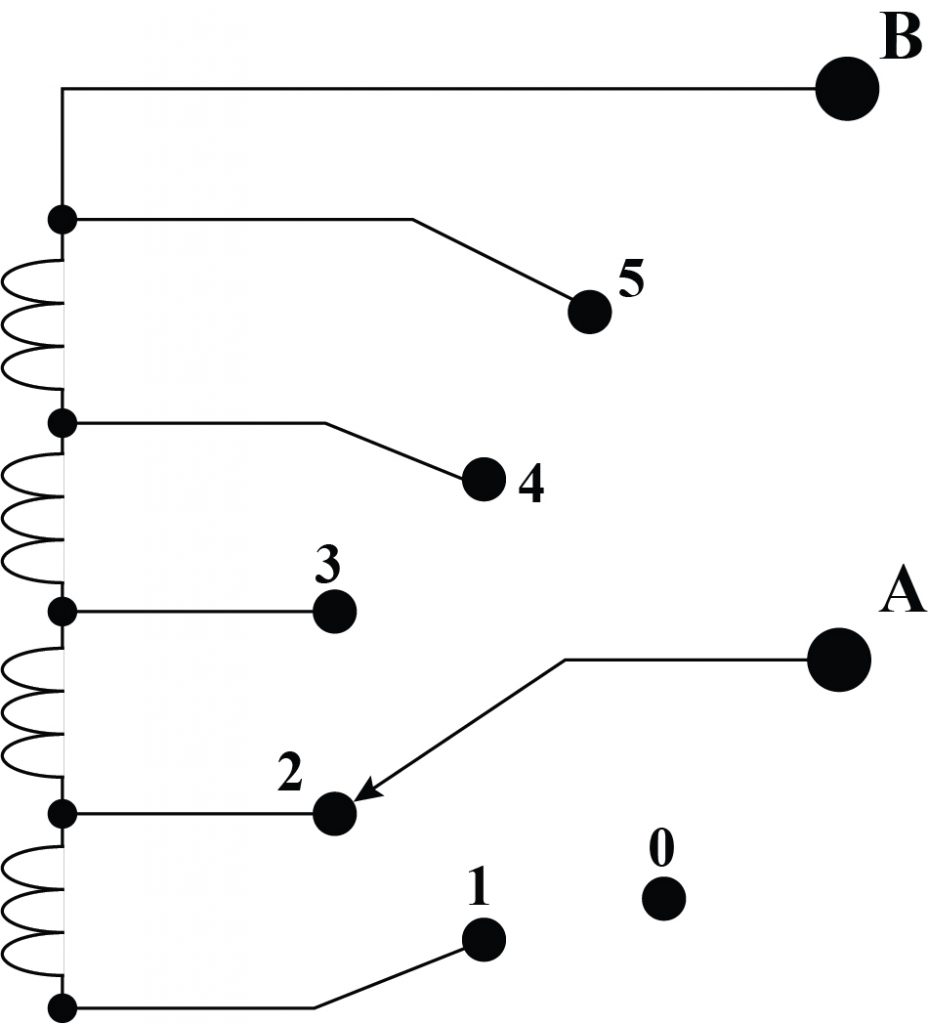
- The resistance between the two ends A and B decreases as we incrementally increase the sequence number from 0 to 5 on the fan controller. Correspondingly, the fan’s speed increases gradually.
- At position 0, the circuit between the two ends A and B is open, which corresponds to turning the fan off.
Downrod (or Fan Rod): This component is used to connect the electric motor housing to the mounting hook inside the upper canopy (or upper funnel) to suspend the ceiling fan.
Upper Canopy (or Upper Cover): In the structure of a ceiling fan, this component is used to conceal the mounting hook, screws, and the electrical junction box on the ceiling.
Junction Box (or Electrical Box): This component is installed on the ceiling and is used to connect the fan’s wiring to the household electrical wiring.
Ceiling Fan Hook: This is an indispensable component when installing a ceiling fan. Whether this component is included depends on whether you purchase directly from the fan distributor. If it is not included, you can still buy it separately. However, be sure to choose a sturdy hook.
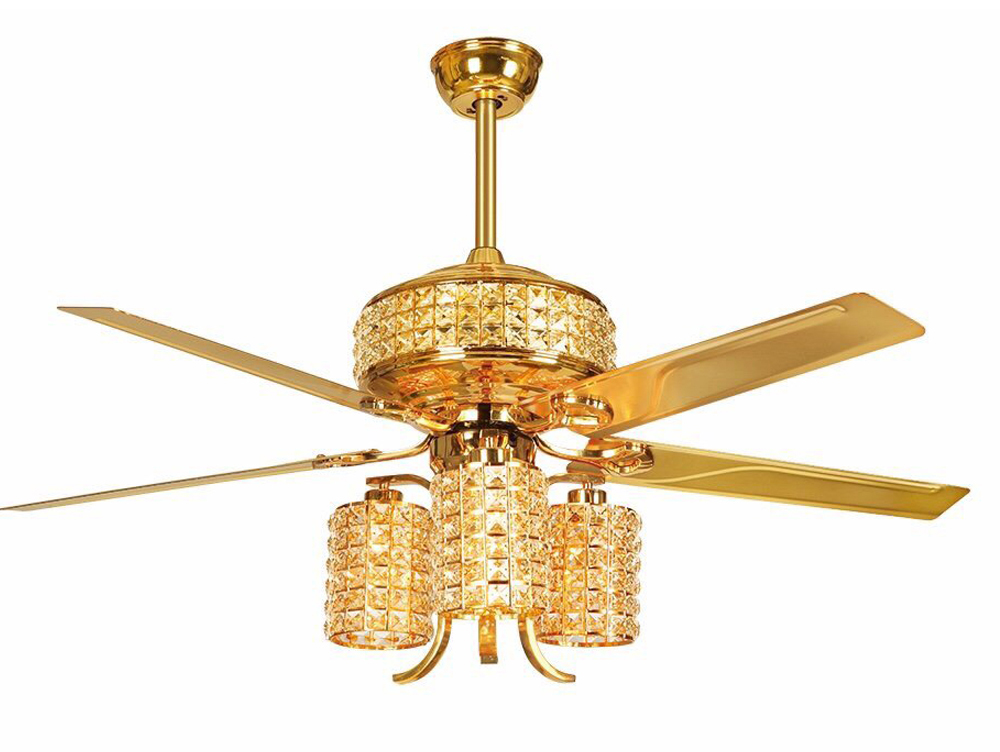
In addition to the main components that enable your ceiling fan to operate for smart and convenient cooling in your home, modern ceiling fans today also feature other parts such as decorative lights, remote controls, etc.
Decorative Lights: The light fixture is installed below the fan blades, coming in either simple styles or elaborate chandelier forms. It provides illumination and decorates the space where the fan is mounted. Many ceiling fan models with lights can emit light in various colors.
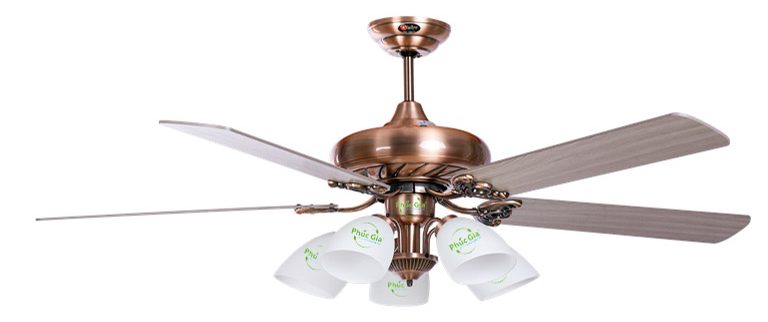
Remote Control (Remote): The remote allows users to easily turn the fan on or off, adjust the wind mode, wind speed, or set a timer from anywhere in the room without having to physically access the wall controller. Many types of ceiling fan remote controls are also equipped with an LED screen for users to conveniently monitor the fan’s operation.
Ceiling Fan Schematic Diagram
By understanding the ceiling fan schematic diagram, users can properly adjust and utilize the product to maximize its operational functions and achieve the desired efficiency.
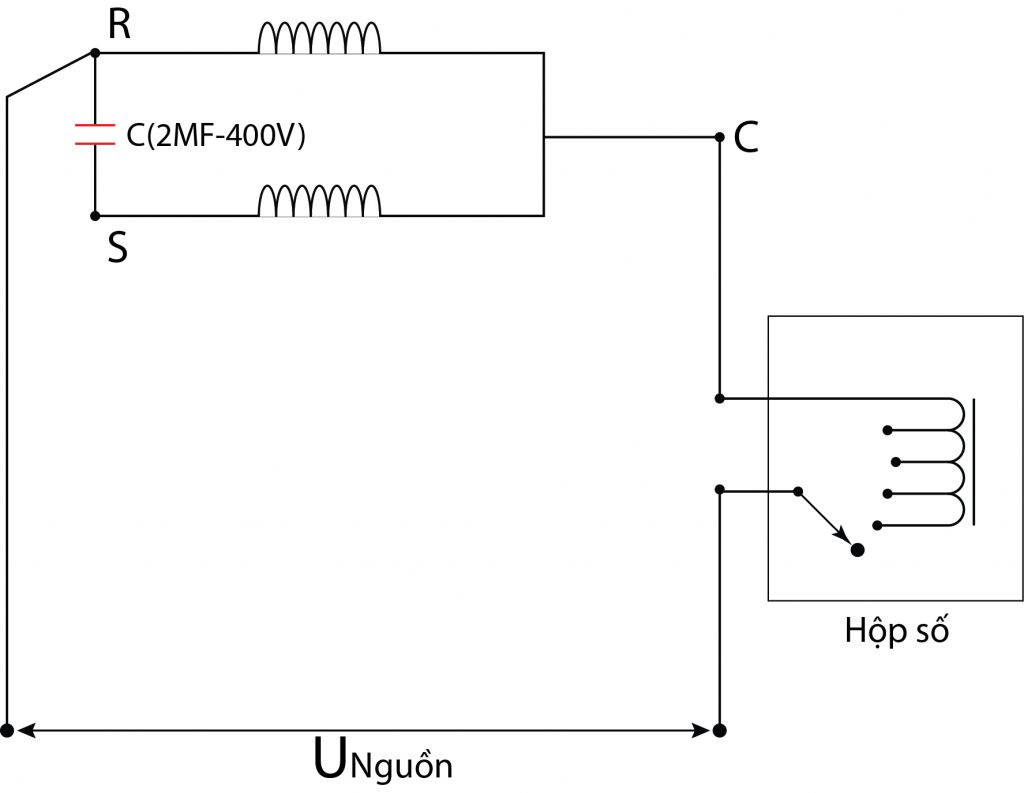
In the diagram:
- R: Running winding lead
- S: Starting winding lead
- C: Common lead
Note: When manufacturing, the producer may produce the ceiling fan with only 3 leads (without marking). Therefore, when installing the fan, you need to properly identify the starting winding lead and the running winding lead to correctly wire the fan according to the operating diagram.
Operating Principle of a Ceiling Fan
- When we flip the power switch or press the button on the Remote, the power supply initiates the startup, causing the motor to rotate.
- Subsequently, the electric motor will begin operation, converting power in the established direction, depending on the speed setting selected by the user.
- The operation of the motor causes the fan blades to turn; when the motor receives the command to operate, the blades attached to the Rotor also rotate in the set direction.
- At that point, the airflow (wind) speed (fast/slow) is determined by the rotational speed of the motor, which is controlled by the speed regulator according to the previous setup.
The intensity of the ceiling fan’s airflow (strong or weak) depends partly on the speed of the motor’s rotation, controlled by the speed regulator, and partly on the fan’s design (such as the degree of blade pitch, blade length, and motor power). For common household ceiling fans, the correct rotation direction of the blades, when viewed from below, is counter-clockwise; if the ceiling fan rotates in reverse, you will feel virtually no cooling effect.
RELATED POSTS:
For more details, please contact us at:
PHUC GIA LABORATORY CORPORATION
PHUC GIA CERTIFICATION CENTER
PHUC GIA INSPECTION TESTING CENTER
Address: ICD Long Bien, No. 01 Huynh Tan Phat, Sai Dong B Industrial Park, Long Bien Ward, Hanoi City, Vietnam.
Hotline: 0981 996 996/ 0982 996 696/ 024 7779 6696
E-mail: lab@phucgia.com.vn
Website: phucgia.com.vn
Working time: Monday to Friday 8:00 – 18:30; Saturday 8:00 – 12:00

![QUOTATION – Testing and Other Certification Services [2026]](https://phucgia.com.vn/wp-content/uploads/2017/03/bao-gia-thu-nghiem-chung-nhan.png)