

Since the concepts and standards for the Specific Absorption Rate (SAR) were introduced, their global application has captured the attention of both consumers and mobile device manufacturers. SAR evaluates the level of Radio Frequency (RF) energy absorption from mobile phones into the human body. This is a critical component in ensuring public safety and health. Aligning with this trend, Vietnam has also demonstrated its commitment by issuing QCVN 134:2024/BTTTT, marking a significant step in ensuring electromagnetic safety and protecting the health of users at a national level, securing the regulatory foundation for SAR in Vietnam. Let Phuc Gia explore the development and Global Management Status of Specific Absorption Rate (SAR).
1. General Status of Specific Absorption Rate in Selected Countries Worldwide
In 2020, standard IEC/IEEE 62209-1528:2020 was issued to synchronize the measurement methods of the two standards published by IEC and IEEE for uniform application in SAR testing. This is also the standard used by European countries, the US, Canada, Taiwan, South Korea, and Indonesia for the SAR testing method.
Research and surveys examining the experience of 52 countries across Europe, the Americas, ASEAN/Asia, Australia, and Africa indicate: (1) 43 surveyed countries mandate SAR management (including 9 out of 10 countries in the ASEAN region that mandate SAR management), (2) For 9 surveyed countries, despite efforts by the drafting unit to find information, it remains unclear whether SAR management is mandatory. Among the 43 countries that mandate SAR management, the following regulations apply:
- Regarding SAR limit levels: All 43 countries apply a limit level of 4 W/kg (for the extremities) and 0.08 W/kg (for the whole body). The limit level for the head and torso regions varies: 39 countries apply a limit of 2 W/kg, while 4 countries (the US, Canada, South Korea, India) apply a limit of 1.6 W/kg (in accordance with the US Federal Communications Commission – FCC limit).
- Regarding the subjects of management: Generally, these are radio-frequency equipment used near the human body, particularly at a distance of less than 20 cm. All 43 countries regulate mobile phones, and some countries also regulate devices such as: Walkie-talkies, tablets, laptops, portable WIFI routers, smartwatches, and others. Some countries implement an exemption for radio-frequency equipment with low transmit power.
(1) The 43 countries include: Europe (17 countries: UK, Poland, Portugal, Bulgaria, Croatia, Czech, Germany, France, Greece, Ireland, Italy, Norway, Russia, Finland, Spain, Sweden, Switzerland); Asia (17 countries: China, Taiwan, South Korea, India, Nepal, Japan, Qatar, Brunei, Cambodia, Laos, Malaysia, Indonesia, Myanmar, Philippines, Singapore, Thailand); the Americas (6 countries: Mexico, Brazil, Canada, Chile, the US, Uruguay); Africa (2 countries: South Africa, Egypt); Australia (1 country: Australia).
(2) The 9 countries include: Peru, Oman, Kuwait, Colombia, Costa Rica, Argentina, Saudi Arabia, New Zealand, and Iran.
(3) France, Japan, and Australia grant exemptions for devices with power below 20 mW; the US and Canada grant exemptions for devices with power below 10 mW.
Direct consultation with the French National Frequency Agency (ANFR) revealed that during product quality checks in 2021, the agency discovered that 13 out of 141 mobile phones did not meet the required permissible SAR limit.
- Regarding the Operating Frequency Range:
Most surveyed countries use the measurement method standard issued by IEC, with the lowest measurement frequency range starting at 4 MHz and the highest at 10 GHz, specifically as follows:
– Europe: Applies the measurement method according to standards IEC 62209-1 and IEC 62209-2 (these two standards are currently replaced by IEC/IEEE 62209-1528:2020). The measurement frequency range is from 300 MHz to 6 GHz.
– The US: Applies the measurement method according to standard IEEE Std 1528:2013. This standard is currently replaced by standard IEC/IEEE 62209-1528:2020. The measurement frequency range is from 300 MHz to 6 GHz.
– Canada: Applies the measurement method according to standard IEC 62209-1528:2020. The measurement frequency range is from 4 MHz to 6 GHz.
– Indonesia: Applies the measurement method according to standard IEC 62209-1528:2020. The measurement frequency range is from 300 MHz to 6 GHz for 3G and LTE devices in the 450 MHz band, and the measurement frequency range is from 10 MHz to 10 GHz for other LTE bands and 5G devices.
– Japan, South Korea: Apply the measurement method according to standards IEC 62209-1/-2 (these two standards are currently replaced by IEC/IEEE 62209-1528:2020 by IEC). The measurement frequency range is from 300 MHz to 6 GHz (Japan).
– Taiwan: Applies the measurement method according to standard IEC 62209-1 (this standard is currently replaced by IEC/IEEE 62209-1528:2020 by IEC). The measurement frequency range is from 100 MHz to 6 GHz.
– India: Applies the measurement method according to standards IEC 62209-1/-2 (these two standards are currently replaced by IEC/IEEE 62209-1528:2020 by IEC). The measurement frequency range is from 100 MHz to 6 GHz.
– Malaysia, Singapore: Apply standard IEC/EN 62209-1 (this standard is currently replaced by IEC/IEEE 62209-1528:2020 by IEC). The measurement frequency range is from 300 MHz to 6 GHz.
(Source: Explanation of the Draft QCVN 134:2024/BTTTT – National Technical Regulation on Specific Absorption Rate for Mobile Phones)
2. Specific Absorption Rate (SAR) Limits and Recommendations in Vietnam and Worldwide
Table 1: SAR Limit Values Recommended by Several Countries
|
Nation |
Specific Absorption Rate (SAR) (W/Kg) |
|
|
For Head and Body |
For Limbs (Arms and Legs) |
|
|
US and Canada |
1.6 W/Kg/1 gram |
4 W/Kg/10 gram |
|
Australia |
2.0 W/Kg/10 gram |
4 W/Kg/10 gram |
|
Europe (EU) |
2.0 W/Kg/10 gram |
4 W/Kg/10 gram |
|
Japan |
2.0 W/Kg/10 gram |
4 W/Kg/10 gram |
|
Korea |
1.6 W/Kg/1 gram |
4 W/Kg/10 gram |
|
India |
1.6 W/Kg/1 gram |
4 W/Kg/10 gram |
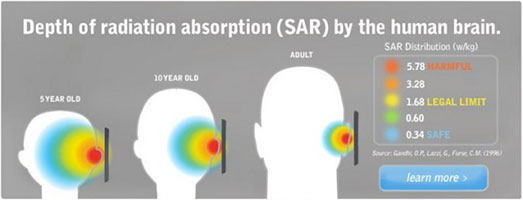
In general, countries that apply the Specific Absorption Rate (SAR) regulatory standards for mobile phones utilize two main regulatory levels. The SAR limit for the head and torso is typically set at the threshold of 1.6 W/kg or 2.0 W/kg, and for the limbs/extremities, the threshold is 4.0 W/kg (depending on the Technical Regulation of each nation).
SAR for the Body and Head: The SAR level for the body is typically measured in watts per kilogram (W/kg). Common levels usually range from 0.1 to 2.0 W/kg.
For example:
- The US regulates the SAR standard at the following level:
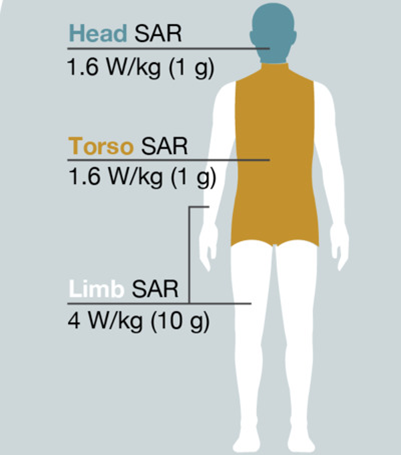
In the United States, the FCC manages SAR according to 47 CFR Part 2, section 2.1093. Products intended for general use must meet an average SAR limit of 1.6 W/kg over one gram of tissue in any part of the head or body, and 4 W/kg averaged over 10 grams for the limbs/extremities.
- Vietnam is currently proposing the SAR standard at the following level:
QCVN 134:2024/BTTTT stipulates:
– Regarding the SAR limit level: Applying a limit of 1.6 W/kg (for the head and torso region), 4 W/kg (for the limbs/extremities), and 0.08 W/kg (for the whole body).
– Regarding the subjects of management: Mobile and handheld devices in the frequency range of 0.1 MHz to 2500 MHz.
3. Conclusion
In the context of the growing development and use of mobile communication devices, the management and assurance of safety concerning the Specific Absorption Rate (SAR) have become a top global priority. This is particularly important as studies continue to affirm a link between prolonged exposure to electromagnetic waves and certain health issues.
Vietnam’s introduction of new regulations on the Specific Absorption Rate in the draft QCVN 134:2024/BTTTT is a critical step aimed at ensuring the safety of users of mobile communication equipment. However, this process is still undergoing discussion and gathering feedback from the community and enterprises, to ensure that the regulation accurately reflects the needs and requirements of both users and manufacturers.
On December 31, 2024, the Ministry of Information and Communications (MIC) (which has merged with the Ministry of Science and Technology) issued QCVN 134:2024/BTTTT on the National Technical Regulation on Specific Absorption Rate for Handheld and Body-Worn Radio Equipment, including mobile phones, DECT phones (handsets), tablets, and laptops.
Based on Circular No. 19/2024/TT-BTTTT, the roadmap for the application of QCVN 134:2024/BTTTT is as follows:
- From February 15, 2025, QCVN 134:2024/BTTTT shall be applied voluntarily in testing, conformity certification, and conformity declaration.
- From July 01, 2026, terrestrial mobile phones must comply (mandatory application) with QCVN 134:2024/BTTTT before being circulated on the market.
- From July 01, 2027, products and goods under the scope of QCVN 134:2024/BTTTT (DECT wireless Subscriber Extension equipment – applying only to the handset, Laptops, Tablets) must comply (mandatory application) with this Technical Regulation before being circulated on the market.
References:
- SAR value – How important and true is it?
- Regional differences in RF exposure regulation
- Global Differences in SAR Regulations
- Electromagnetic fields: Exposure limits for radio-frequency fields
- Electromagnetic fields and public health: mobile phones
The global management of Specific Absorption Rate (SAR) is characterized by a patchwork of harmonized standards and regional variations, all aimed at ensuring consumer safety from radiofrequency (RF) energy absorption. While international bodies like ICNIRP and the IEC establish foundational guidelines, major markets implement distinct legal limits and testing protocols. For instance, North America (FCC/ISED) mandates a limit of 1.6 W/kg averaged over 1 gram of tissue, whereas the European Union (CE) requires 2.0 W/kg averaged over 10 grams. This difference in averaging volume significantly impacts reported values, making direct cross-regional comparisons unreliable for consumers. Ultimately, strict regulatory compliance and accurate SAR testing remain a crucial, mandatory step for manufacturers to confidently gain market access for all wireless devices.
RELATED POSTS:
- Overview of the Draft QCVN 134:2024/BTTTT – National Technical Regulation on Specific Absorption Rate for Mobile Phones
- What is SAR? Testing Methodology and the Latest Updates
- Compilation of Legal Regulations for the Production and Import of Mobile Phones
For more details, please contact us at:
PHUC GIA LABORATORY CORPORATION
PHUC GIA CERTIFICATION CENTER
PHUC GIA INSPECTION TESTING CENTER
Address: ICD Long Bien, No. 01 Huynh Tan Phat, Sai Dong B Industrial Park, Long Bien Ward, Hanoi City, Vietnam
Hotline: 0981 996 996/ 0982 996 696/ 024 7779 6696
E-mail: lab@phucgia.com.vn
Website: phucgia.com.vn
Working time: Monday to Friday 8:00 – 18:30; Saturday 8:00 – 12:00

![QUOTATION – Testing and Other Certification Services [2026]](https://phucgia.com.vn/wp-content/uploads/2017/03/bao-gia-thu-nghiem-chung-nhan.png)