

See more: Capacity Profile Of Phuc Gia Laboratory Corporation
What is an HID lamp?
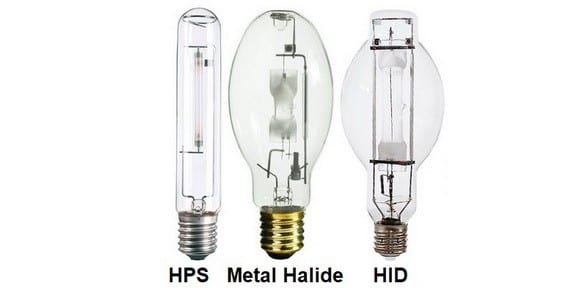
An HID (High Intensity Discharge) lamp is a lighting fixture that includes an HID bulb, a ballast, a reflector, and a mounting hook. HID is a general term for various types of lamps, including: Mercury vapor lamps, Metal halide lamps, HPS lamps, Xenon lamps, etc. All types of HID lamps require a ballast to convert AC current into the energy needed to power the HID bulb.
HID bulbs emit omnidirectional light, meaning the light is radiated in all directions. To focus the light, reflectors and lenses are used to direct the light to where it is needed. HID bulbs are typically very bright, but they require a warm-up period to reach their maximum brightness. If you turn the light off, the bulb must cool down before it can be restarted, and the time required to regain full brightness is quite long. The two most common types of HID bulbs are Sodium lamps (LPS & HPS) and metal halide lamps. Sodium lamps produce a yellow light, while metal halide lamps emit white light.
HID Lamp Lifespan
HID lamps have varying lifespans ranging from 15,000 to 20,000 hours (whereas LED chips can reach up to 50,000 hours). Light output gradually decreases throughout the lamp’s life. An HID lamp can lose more than 50% of its light output by the time it reaches half of its lifespan. At 80% of its lifespan, it may only emit 20% of its original light output. Therefore, it is not surprising that bulbs often need to be replaced even before they officially burn out.
Another phenomenon as HID lamps age is the shift in light color. For white HID lamps, the light may turn bluish or purple.
HID Lamp Applications
HID lamps are used for applications requiring high brightness. Indoor applications include gyms, warehouses, high-bay lighting, and factory lights. Outdoor applications include parking lots, stadiums, street lights, and area lighting. HID bulbs come in various wattages for different uses.
- Smaller fixtures requiring less light typically use 100W – 150W lamps.
- Smaller bulbs used for high-bay lighting and parking lots use 250W – 400W lamps.
- Large fixtures typically use HID bulbs with wattages of 1000W, 1500W, and 2000W.
Switching from HID to LED
Why do people switch from HID to LED? About 11 years ago, LEDs were certainly not bright enough to replace HIDs. Simply put, they were both expensive and inefficient. But today, LED technology has matured, and costs have dropped significantly. LEDs are capable of emitting more light with much less energy than HIDs, and they offer several additional advantages:
- LEDs are more efficient, using less than 25% of the energy to produce the same amount of light as an HID lamp.
- The lifespan of LEDs is much longer than HIDs. While HID lamps have a maximum lifespan of 20,000 hours—or only 10,000 hours based on L50 standards—modern L70 standard LEDs can last up to 100,000 hours.
- The light purity of LEDs is much better than HIDs. While some metal halide lamps have a high CRI, almost all LEDs feature high CRI ratings. In contrast, HPS lamps have quite low CRI values.
For more details, please contact us at:
PHUC GIA LABORATORY CORPORATION
PHUC GIA CERTIFICATION CENTER
PHUC GIA INSPECTION TESTING CENTER
Address: ICD Long Bien, No. 01 Huynh Tan Phat, Sai Dong B Industrial Park, Long Bien Ward, Hanoi City, Vietnam.
Hotline: 0981 996 996/ 0982 996 696/ 024 7779 6696
E-mail: lab@phucgia.com.vn/cert@phucgia.com.vn/info@phucgia.com.vn
Website: phucgia.com.vn
Working time: Monday to Friday 8:00 – 18:30; Saturday 8:00 – 12:00

![QUOTATION – Testing and Other Certification Services [2026]](https://phucgia.com.vn/wp-content/uploads/2017/03/bao-gia-thu-nghiem-chung-nhan.png)