

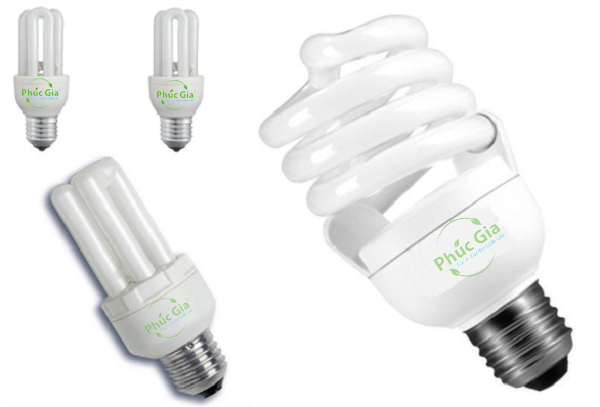
When purchasing good, suitable lamps, we need to ask questions like: what type of lamp to buy?, what are the color and brightness levels? … to fit the living space and illumination area. One crucial measure of a lamp’s brightness is Illuminance. To better understand this, let’s explore with Phuc Gia Lab what Illuminance is, how the Illuminance formula is calculated, and some common applications of Illuminance today.
See more: Capacity Profile Of Phuc Gia Laboratory Corporation
What is Illuminance?
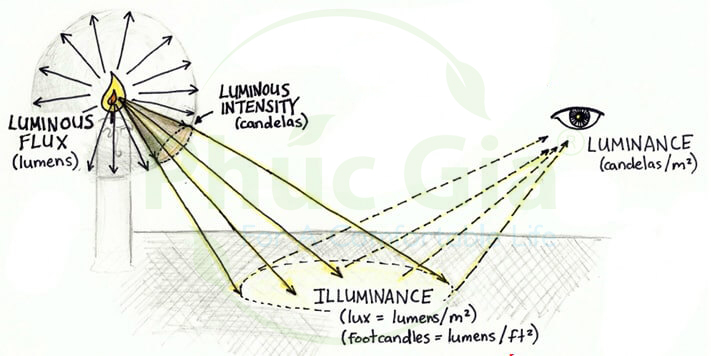
Illuminance is the unit expressing the brightness at a point, also known as the luminous flux over a surface area, which humans perceive as strong or weak. Its unit of measurement is lux.
The symbol for Illuminance is: E

Illuminance is also a key criterion when selecting LED lamps today. While everyone has different preferences, it is essential to ensure that minimum standards for Illuminance are met, guaranteeing the most appropriate lighting for the space.
What is LUX?
Lux is the unit used for calculating light power, representing the amount of light falling on a specific surface. The quantity of lumens per square meter = lux.
Lux is utilized to determine the required light intensity in offices, schools, and other workplaces. The reason for clearly defining lux per square meter is to optimize the functionality of the space.
The formula for calculating lux illuminance:
Illuminance is calculated using the formula: E=Φ/S.
The unit of measurement for Illuminance is lux.

Meaning: Lumen/ m2 = lux

Alternatively, Illuminance can be calculated using a formula if the reflection index and maintenance factor are known, which is necessary for detailed designs involving ceilings, walls, floors, paint colors, and furniture colors. (In this context: luminous flux is the luminous efficacy per 1W of the lamp as published by the supplier)

Where: The reflection coefficients for walls, ceiling, and floor are 80%, 50%, and 20% respectively (applicable for office environments).
Based on this simple formula, it’s clear that for the same lamp type and power, a higher luminous flux means fewer lamps are required. This allows consumers to save on both initial investment costs and ongoing electricity consumption.
Natural Lighting Standards
The Illuminance from natural light reaching the ground constantly changes; it depends on the time of day, cloud cover, and the reflective properties of the ground. Therefore, according to scientific research, lighting fixtures like chandeliers, pendant lights, wall lights, table lamps, and floor lamps must adhere to natural lighting standards to provide a level of natural light that is beneficial for human health.
This Illuminance standard is currently applied across residential lighting, office lighting, public building lighting, and factory lighting. The following are standard Illuminance levels for natural light:
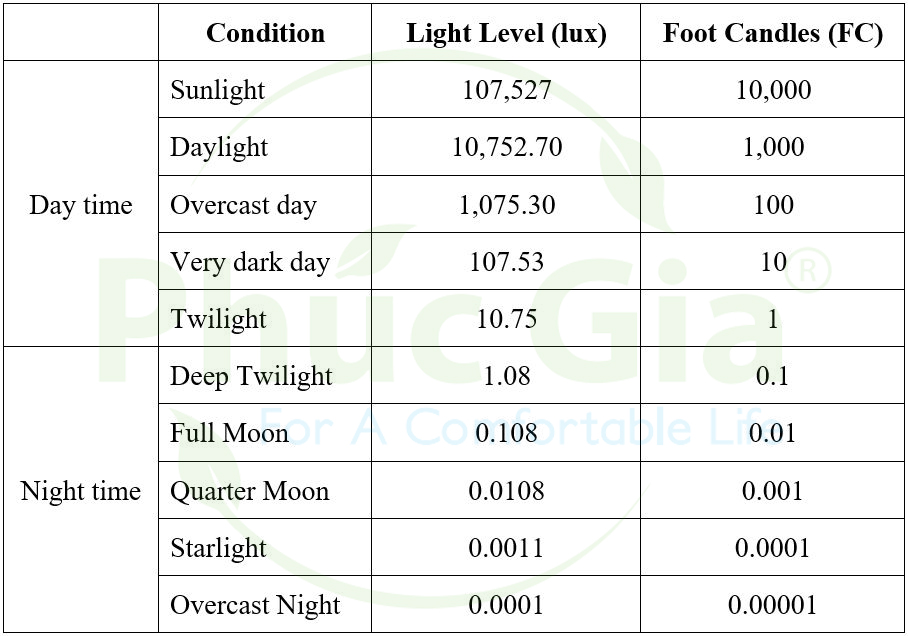
- 32,000 – 100,000 lux: Average Illuminance of direct sunlight during the day
- 10,000 – 25,000 lux: Illuminance of full daylight (not direct sunlight)
- 1,000 lux: Illuminance on an overcast day. This is also the Illuminance level used in television studios
- 400 lux: Illuminance at dawn or dusk (on a clear day)
- 320 – 500 lux: Typical office lighting Illuminance
- 1 lux: Illuminance from reflected moonlight
- 0.00005 lux: Illuminance from starlight
Standard Indoor Illuminance

Distinguishing Between Illuminance (lux) and Luminous Flux (lumen)
The key difference between Illuminance and luminous flux is that Illuminance is calculated based on the area over which the luminous flux is distributed.
The farther a point is from the source, the larger and more spread out the illuminated area becomes. Consequently, the Illuminance at that distant point will be much weaker than at points closer to the light source. While Illuminance changes with distance, the total luminous flux remains constant, regardless of position.
Example: If 2,000 lumens are concentrated onto a 1m² area, it will light up that area with an Illuminance of 2000 lx. If those same 2000 lumens are spread out over a 10m² area, the Illuminance will be much dimmer, at only 200 lx.
To achieve the same Illuminance value over a larger area, significantly more lumens are required.
Relation between Illuminance and Lux Luminous Intensity
Consider a point M on a surface S, located at a distance r from a light source O. The angle between the light ray OM and the normal (perpendicular) line O to the surface S is alpha. The horizontal Illuminance at point M is calculated as:
E= (Iα x cosα)/r2
This formula shows that the lux luminous intensity depends only on the direction, not the distance. Illuminance, however, depends on both the direction and decreases with the square of the distance.
Relation Between Illuminance and Power
Illuminance is a derived unit; it does not measure light energy directly but rather the human eye’s perception of light. Therefore, the conversion factor varies with the wavelength (or color temperature) of the light.
At a wavelength of 555m (the middle of the visible spectrum), 1 lx is equivalent to 1.46 mW/m².
We hope this article, “What is Illuminance and the formula for calculating Illuminance,” helps you understand the concept clearly and aids you in designing the most appropriate lighting solutions.
For more details, please contact us at:
PHUC GIA LABORATORY CORPORATION
PHUC GIA CERTIFICATION CENTER
PHUC GIA INSPECTION TESTING CENTER
Address: ICD Long Bien, No. 01 Huynh Tan Phat, Sai Dong B Industrial Park, Long Bien Ward, Hanoi City, Vietnam.
Hotline: 0981 996 996/ 0982 996 696/ 024 7779 6696
E-mail: lab@phucgia.com.vn
Website: phucgia.com.vn
Working time: Monday to Friday 8:00 – 18:30; Saturday 8:00 – 12:00

![QUOTATION – Testing and Other Certification Services [2026]](https://phucgia.com.vn/wp-content/uploads/2017/03/bao-gia-thu-nghiem-chung-nhan.png)