

The list of commodities subject to Energy Efficiency Inspection in Vietnam is increasingly expanding, requiring enterprises and manufacturers to stay fully updated to avoid violations. Let’s join Phuc Gia® to explore the list of products requiring Energy Efficiency Inspection in Vietnam according to the regulations of the Ministry of Industry and Trade, along with important requirements that enterprises need to note in this article!
See more: Capacity Profile Of Phuc Gia Laboratory Corporation
1. What is Energy Efficiency Inspection?
To clearly understand the concept of Energy Efficiency Inspection, enterprises need to grasp the definitions below.
- According to Clause 9, Article 3 of the Law on Economical and Efficient Use of Energy 2010: “Energy efficiency is an indicator for the capability of a machine or a piece of equipment to convert consumed energy into useful energy.”
- An energy label is information attached to a product (which can be pasted, printed, attached, or engraved) providing data on the type of energy used, consumption level, and energy efficiency, helping consumers choose energy-saving equipment.
- According to Clause 10, Article 3 of the Law on Economical and Efficient Use of Energy 2010: “Minimum Energy Performance Standards (MEPS) is the lowest energy efficiency level prescribed by a competent state agency for energy-using means and equipment, below which the equipment will be subject to special management.”
- Energy Efficiency Inspection for minimum levels is the process of evaluating whether a device meets the lowest energy efficiency level according to legal regulations. This is a mandatory requirement to eliminate products that consume excessive electricity, helping to protect consumers and save energy.

Energy Efficiency Inspection in Vietnam is the basis for energy labeling, helping consumers easily identify and select energy-saving products. Energy labeling plays an important role in:
- Cost savings: Helping consumers easily choose energy-saving equipment, reducing electricity bills.
- Environmental protection: Reducing electricity consumption helps reduce CO₂ emissions, decreases negative environmental impacts, and contributes to the Net Zero goal.
- Promoting green production: Consumer priority for energy-saving products creates motivation for enterprises to innovate technology and develop more efficient, environmentally friendly equipment. This contributes to building sustainable production chains and a long-term consumer market.
- Regulatory compliance: Energy labeling is a mandatory requirement for many product groups according to legal regulations. Enterprises that do not comply correctly may face administrative penalties, goods recall, or refusal of Customs Clearance.
- Raising awareness: Energy Efficiency Inspection in Vietnam and labeling help consumers access necessary information to clearly understand the electricity consumption and operational performance of products. Thereby, users form energy-saving consumption habits and become more responsible toward the environment and society.
The process of Energy Efficiency Inspection in Vietnam and energy labeling not only helps consumers optimize costs but also helps manufacturing and import-export enterprises enhance their reputation, expand markets, and meet legal requirements in many countries.
2. Regulations on Energy Efficiency Inspection
Vietnam has implemented energy labeling regulations since 2006, under Decision No. 79/2006/QĐ-TTg of the Prime Minister, to promote economical and efficient energy use. Important regulations related to Energy Efficiency Inspection in Vietnam include:
- Decision No. 1427/QĐ-TTg (2012) approving the National Target Program on Economical and Efficient Use of Energy for the 2012 – 2015 period, issued by the Prime Minister on October 2, 2012.
- Decision No. 04/2017/QĐ-TTg (2017) regulating the list of machines and equipment subjecting to energy labeling, applicable Minimum Energy Performance Standards (MEPS), and the implementation roadmap issued by the Prime Minister on April 25, 2017.
- Circular No. 36/2016/TT-BCT (2016) regulating energy labeling for energy-using means and equipment under the management of the Ministry of Industry and Trade, issued by the Ministry of Industry and Trade (MOIT) on December 28, 2016.
- Decision No. 1725/QĐ-BCT (2024) regulating the list of items subject to Energy Efficiency Inspection and energy labeling under the management responsibility of the Ministry of Industry and Trade, issued by the Ministry of Industry and Trade on June 17, 2024.
- Decision No. 14/2023/QĐ-TTg (2023) replacing Decision No. 24/2018/QĐ-TTg, regulating the list and roadmap for phasing out low-efficiency energy equipment issued by the Prime Minister on May 24, 2023.
- Circular No. 31/2022/TT-BTC (2022) regulating the Nomenclature of Vietnam’s exports and imports, related to HS codes cited in specialized inspection documents, effective from June 8, 2022.
- Implementation according to TCVNs (National Standards) on energy efficiency applied to each equipment group (e.g., TCVN 7830:2015/2021 for air conditioners, TCVN 7896:2015 for fluorescent lamps…), issued by the Ministry of Science and Technology (MOST) and cited in the aforementioned Decisions/Circulars.
In addition to the above documents, there are many other specialized guiding decisions and circulars related to specific equipment groups (such as refrigerators, air conditioners, washing machines, light bulbs…) along with regulations on implementation roadmaps, administrative penalties, import conditions, and obligations for Declaration of Conformity/Standard Conformity, issued by authorities such as the Ministry of Industry and Trade, the Ministry of Science and Technology, the Ministry of Finance, etc.
Enterprises need to regularly update the latest documents to ensure proper compliance when importing, distributing, or manufacturing energy-using equipment.

3. List of items subject to energy efficiency inspection and energy labeling under the management of the Ministry of Industry and Trade
The Ministry of Industry and Trade issued Decision No. 1725/QĐ-BCT on July 1, 2024, identifying the list of items requiring Energy Efficiency Inspection and energy labeling. This Decision includes the following products:
The Ministry of Industry and Trade issued Decision No. 1725/QĐ-BCT on July 1, 2024, identifying the list of items requiring Energy Efficiency Inspection and energy labeling. This Decision includes the following products:
| HS Code | Product Names According to Circular No. 31/2022/TT-BTC | Product Description | Technical Regulations/Standards | Note |
| Commodities subject to Energy Efficiency Inspection according to Decision No. 04/2017/QĐ-TTg dated March 9, 2017, and Decision No. 14/2023/QĐ-TTg dated May 24, 2023, of the Prime Minister | ||||
| 8539.31 | Hot-cathode fluorescent lamps | Fluorescent Lamps | ||
| 8539.31.10 | Fluorescent tubes for compact fluorescent lamps | Compact Fluorescent Lamps (CFL) | TCVN 7896:2015 | Only apply to lamps with a power from 5W to 60W |
| 8539.31.20 | Other, double-capped linear fluorescent lamps for other fluorescent lamps | Linear fluorescent lamps (FL) | TCVN 8249:2013 | Only apply to lamps with a power from 4W to 65W |
| 8539.31.30 | Self-ballasted compact fluorescent lamps | Compact Fluorescent Lamps (CFL) | TCVN 7896:2015 | Only apply to lamps with a power from 5W to 60W |
| 8504.10.00 | Ballasts for discharge lamps or tubes | Electromagnetic ballasts for fluorescent lamps | TCVN 8248:2013 | Only apply to power from 4W to 65W |
| 8504.10.00 | Ballasts for discharge lamps or tubes | Electronic ballasts for fluorescent lamps | TCVN 7897:2013 | |
| 8418.10
|
Combined refrigerator-freezers (equipment with separate freezing and cooling compartments), with separate external doors or drawers, or a combination thereof: | Refrigerators, Commercial refrigerated cabinets, Freezers | TCVN 7828:2016 | Only apply to cabinets up to 1000L. Type of cabinet with natural convection or forced air cooling. Do not apply to absorption refrigerators, commercial cabinets, specialized cooling equipment. |
| With separate doors only: | ||||
| 8418.10.31 | Household type, with a capacity not exceeding 230 liters | |||
| 8418.10.32 | Other household type, with a capacity exceeding 230 liters | |||
| 8418.10.39 | Other | |||
| 8418.10.91 | Counters, show-cases and similar cabinets, equipped with refrigerating equipment, capacity exceeding 200 liters | |||
| 8418.10.99 | Other | |||
| Refrigerators, household type: | ||||
| 8418.21 | Compression-type: | |||
| 8418.21.10 | Capacity not exceeding 230 liters | |||
| 8418.21.90 | Other | |||
| 8418.29.00 | Other | |||
| 8418.30 | Freezers, chest type, capacity not exceeding 800 liters: | |||
| 8418.30.10 | Capacity not exceeding 200 liters | |||
| 8418.30.90 | Other | |||
| 8418.40 | Freezers, upright type, capacity not exceeding 900 liters: | |||
| 8418.40.10 | Capacity not exceeding 200 liters | |||
| 8418.40.90 | Other | |||
| 8418.50 | Other furniture (chests, cabinets, display counters, showcases and the like) for storage or display, incorporating refrigerating or freezing equipment: | |||
| Showcases, counters and the like, incorporating refrigerating equipment, capacity exceeding 200 liters: | ||||
| 8418.50.19 | Other | |||
| 8418.50.99 | Other | |||
| 8516.60.10 | Electric Rice Cookers | Electric rice cookers | TCVN 8252:2015 | Only apply to types up to 1000W |
| 8414.51 | Table, floor, window, wall, ceiling or roof ventilation fans, with a self-contained electric motor of an output not exceeding 125 W | Electric fans | TCVN 7826:2015 | |
| 8414.51.10 | Table fans and box fans | |||
| Other: | ||||
| 8414.51.91 | With protective screen | |||
| 8414.51.99 | Other | |||
| 8528.72.92 | Light emitting diode (LED) monitors, liquid crystal display (LCD) monitors, and other flat panel monitors | Television receivers | TCVN 9536:2012 | |
| 8528.72.99 | Other | |||
| 8516.10 | Instantaneous water heaters or immersion heaters and storage water heaters | Storage water heaters | TCVN 7898:2009 | Electric storage water heaters for household or similar purposes with a capacity up to 40 liters (TCVN 7898:2009)
Electric storage water heaters for household or similar purposes with a capacity up to 40 liters (TCVN 7898:2018) This standard does not apply to water heating appliances for drinking. |
| Instantaneous water heaters or storage water heaters: | ||||
| 8516.10.19 | Other | |||
| 8415.10.20 | Cooling capacity not exceeding 21.10 kW | Air conditioners | TCVN 7830:2015 | This standard specifies energy efficiency levels and performance determination methods for ductless air conditioners, using hermetic motor-compressors and air-cooled condensers, with a maximum cooling capacity of 12,000 W (41,000 BTU/h).
The standard does not apply to water-cooled, ducted, portable, floor-standing, ceiling-mounted air conditioners, multi-split systems with more than two units, or those using three-phase power. |
| 8450.11 | Fully automatic machines: | Household washing machines | TCVN 8526:2013 | Only apply to equipment with a capacity from 2 kg to 15 kg of dry cloth per wash. |
| 8450.11.10 | Models with a dry linen capacity not exceeding 6 kg per wash | |||
| 8450.11.90 | Other | |||
| 8450.12 | Other washing machines, with centrifugal drying function: | |||
| 8450.12.10 | Models with a dry linen capacity not exceeding 6 kg per wash | |||
| 8450.12.90 | Other | |||
| 8450.19 | Other: | |||
| Electrically operated: | ||||
| 8450.19.11 | Models with a dry linen capacity not exceeding 6 kg per wash | |||
| 8450.19.19 | Other | |||
| Other: | ||||
| 8450.19.91 | Models with a dry linen capacity not exceeding 6 kg per wash | |||
| 8450.19.99 | Other | |||
| 8450.20.00 | Washing machines, with a capacity exceeding 10 kg of dry linen per wash | |||
| 8539.52 | Light-emitting diode (LED) lamps: | LED lamps | TCVN 11844:2017 | Only apply to lamps with integrated ballasts and E27 or B22 caps, and tubular lamps with G5 or G13 caps with power up to 60W and voltage not exceeding 250V.
LED luminaires for road and street lighting, power ≥ 20W, including those with remote control gear. |
| 8539.52.10 | Screw-type lamp base | |||
| 8539.52.90 | Other | |||
| 8443.39.10 | Electrostatic photocopying apparatus, operating by reproducing the original image directly onto the copy (direct process) | Photocopiers | TCVN 9510:2012 | |
| 8443.39.30 | Other photocopying apparatus incorporating an optical system | |||
| 8443.31 | Machines which perform two or more of the functions of printing, copying or facsimile transmission, capable of connecting to an automatic data processing machine or to a network: | Printers | TCVN 9509:2012 | |
| Printer-copiers, printers using ink-jet printing technology: | ||||
| 8443.31.11 | Color Printing Type | |||
| 8443.31.19 | Other | |||
| Printer-copiers, printers using laser printing technology: | ||||
| 8443.31.21 | Color Printing Type | |||
| 8443.31.29 | Other | |||
| Combined printer-copier-fax machines: | ||||
| 8443.31.31 | Color Printing Type | |||
| 8443.31.39 | Other | |||
| Other: | ||||
| 8443.31.91 | Combined printer-copier-scan-fax machines | |||
| 8443.31.99 | Other | |||
| 8528.72.92 | Liquid crystal display (LCD) monitors, other flat panel monitors, and light-emitting diode (LED) monitors. | Computer monitors | TCVN 9508:2012 | Apply to monitors up to 24 inches
Exclude monitors used in medical or specialized industrial applications |
| 8471.30.20 | Laptop computers, including notebooks and subnotebooks | Laptops | TCVN 11848:2017 | |
| 8471.41.10 | Personal computers other than portable computers of subheading 8471.30 | Desktop Computers | TCVN 13371:2021 | |
| 8471.41.90 | Other | |||
| 8471.49.10 | Personal computers other than portable computers of subheading 8471.30 | |||
| 8471.49.90 | Other | |||
| 8501.52 | Capacity over 750W and less than 75kW | Electric motors | TCVN 7450-1:2013 | Apply to 3-phase squirrel-cage induction electric motors, power from 0.75kW to 150kW, maximum nominal voltage of 1000V, with 2, 4, or 6 poles, operating in S1 mode. Exclude the following cases:
|
| Capacity not exceeding 1 kW: | ||||
| 8501.52.19 | Other | |||
| Capacity over 1 kW but not exceeding 37.5 kW: | ||||
| 8501.52.29 | Other | |||
| Capacity over 37.5 kW but not exceeding 75 kW: | ||||
| 8501.52.39 | Other | |||
| 8501.53.90 | Other | |||
| 8402.11.20 | Not electrically operated | Industrial boilers | TCVN 8630:2010 | |
| 8402.12.21 | Boilers with a steam capacity greater than 15 tons/hour | |||
| 8402.12.29 | Other | |||
| 8402.19.21 | Boilers with a steam capacity greater than 15 tons/hour | |||
| 8402.19.29 | Other | |||
| 8402.20.20 | Not electrically operated | |||
| 8504.21 | Having a capacity not exceeding 650 kVA | Transformers | TCVN 8525:2015 | 3-phase distribution transformers with a nominal capacity from 25kVA to 2,500 kVA, including dry-type transformers. |
| 8504.21.19 | Other | |||
| 8504.21.93 | Having a nominal capacity over 10 kVA and high voltage side from 66 kV or higher, but below 110 kV | |||
| 8504.21.99 | Other | |||
| 8504.22 | Capacity over 650 kVA but not exceeding 10,000 kVA | |||
| Step-type voltage regulators (autotransformers): | ||||
| 8504.22.11 | High voltage side from 66 kV or higher | |||
| 8504.22.19 | Other | |||
| Other: | ||||
| 8504.22.92 | High voltage side from 110 kV or higher | |||
| 8504.22.93 | High voltage side from 66 kV or higher, but below 110 kV | |||
| 8504.22.99 | Other | |||
This list is issued to clearly identify products that must undergo energy efficiency testing, energy labeling, and meet minimum energy efficiency levels in accordance with legal regulations. The announcement of this list helps enterprises accurately determine the types of vehicles and equipment subject to testing, labeling, and related obligations, thereby ensuring regulatory compliance while contributing to energy saving and environmental protection.
4. Energy Efficiency Inspection Process
Compliance with the energy efficiency inspection process not only helps enterprises minimize operating costs but also ensures adherence to environmental and energy regulations. Within this, “energy efficiency inspection” is an activity for testing the energy efficiency of products to determine energy consumption levels and energy efficiency levels compared to current standards.
Below are the basic steps in the energy efficiency inspection process.
Step 1: Registration for quality and energy efficiency inspection
Before completing customs procedures, enterprises need to submit an application for product quality and energy efficiency inspection at the Department of Standards, Metrology, and Quality where the declaration is opened. Simultaneously, register for energy efficiency testing at a laboratory designated by the Ministry of Industry and Trade.
After registration, the enterprise will receive a registration confirmation, which is a necessary document to proceed with opening the import declaration.
Step 2: Opening the customs declaration
When opening the declaration, enterprises must attach the confirmation of having registered for quality and energy efficiency inspection. During the routing process, if the declaration is assigned to a specialized inspection channel (usually yellow or red), the customs authority will request additional documents or test results before clearance.
Step 3: Sending product samples for testing
Product samples will be sent to a qualified laboratory designated by the Ministry of Industry and Trade. The equipment will be evaluated for energy efficiency based on National Standards (TCVN) or international standards corresponding to each type of goods.
Step 4: Receiving test report
After testing, if the product meets the minimum energy efficiency levels as prescribed, the enterprise will be issued a test result report or a certificate of energy efficiency conformity. In case the product does not pass, the enterprise must handle it according to the instructions of the specialized agency.
Testing time and costs will vary depending on the type of product and the performing unit.
Step 5: Submitting results and completing customs clearance
The test results are additionally submitted to the customs authority to complete official customs clearance procedures. Customs clearance is only accepted when the product meets energy efficiency requirements and has sufficient valid documents.
Step 6: Declaration of efficiency and energy labeling
After customs clearance, enterprises need to proceed with declaring the energy efficiency level to the Ministry of Industry and Trade (via the online system or according to the instructions in Circular 36/2016/TT-BCT issued on December 28, 2016).
Finally, the energy label will be attached directly to the product or packaging as regulated, in order to provide clear information to consumers about the energy-saving level of the equipment.
5. Phuc Gia – A Prestigious Energy Efficiency Testing Unit
When choosing an energy efficiency testing unit, enterprises need a reliable partner with high expertise and a strict inspection process. Phuc Gia is proud to be a prestigious energy efficiency testing unit, fully meeting inspection standards, helping enterprises ensure regulatory compliance and enhance product value in the market.
5.1. Why should you choose Phuc Gia for energy efficiency testing?
Phuc Gia Inspection and Testing Center, under Phuc Gia Laboratory Corporation (since July 15, 2016), is an Energy Efficiency testing unit designated by the Ministry of Industry and Trade according to the decision dated July 22, 2019. Phuc Gia has become a reliable inspection and testing unit for leading brands such as Ariston, Samsung, Daikin, Panasonic, Apple, LG…
Below are the reasons why enterprises and manufacturers of electrical and electronic equipment should choose Phuc Gia for energy efficiency testing:
- Ministry of Industry and Trade: Energy efficiency testing for 21 groups of electrical – electronic products (General LED lamps, Street LED lamps, Televisions, Refrigerators, Air conditioners, Computers, Induction cookers, Infrared cookers…)
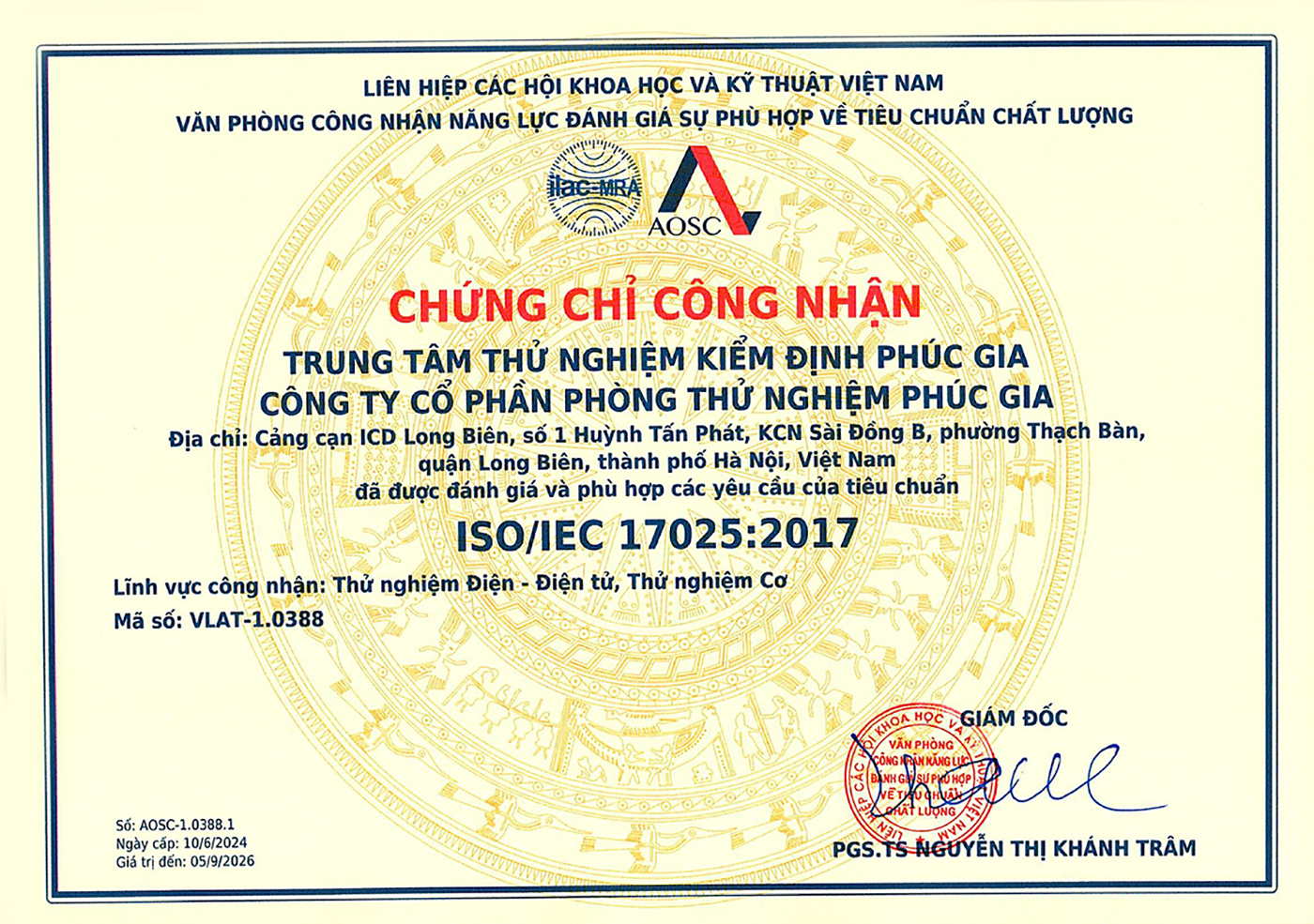
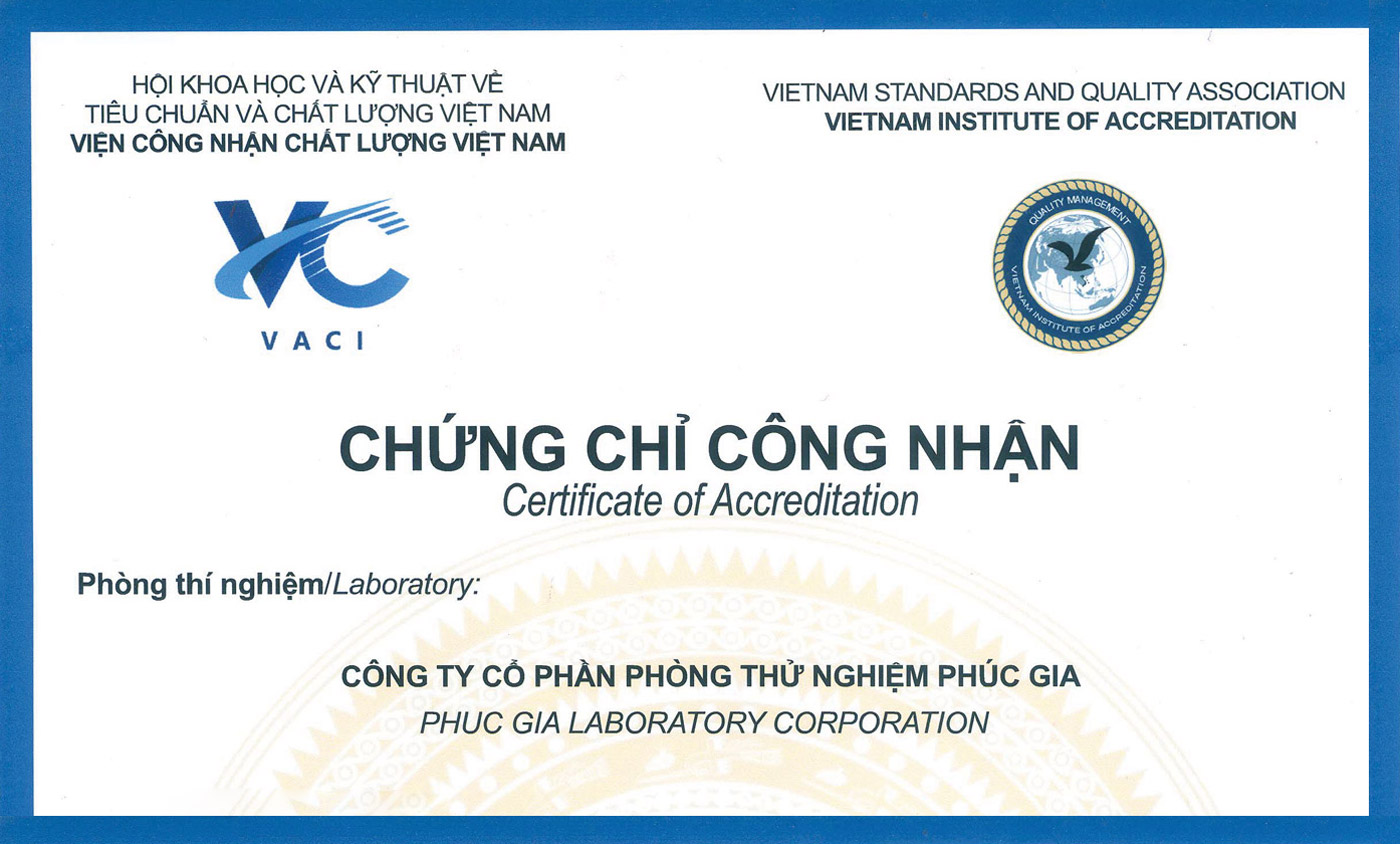
- Recognized according to international standards: Phuc Gia® is currently simultaneously applying two quality management systems according to ISO/IEC 17025 for testing activities and ISO/IEC 17065 for certification activities. In particular, Phuc Gia is the first unit in Vietnam to be recognized by all three conformity assessment accreditation organizations, including the Vietnam Bureau of Accreditation (BoA – code VILAS 1212), the AOSC Accreditation Office (code VLAT 1.0388), and the Vietnam Accreditation Institute (VACI – code VALAS 09) as meeting ISO/IEC 17025:2017 standards. This achievement confirms the professional capacity, transparency, and reliability of Phuc Gia in the field of testing and certification.
- Modern equipment: With a facility area of over 4,000m², the laboratories are arranged close to each other, creating convenience when performing multiple tests. Phuc Gia is also the first private unit to invest in an air conditioner energy efficiency test chamber with a capacity of up to 60,000 BTU/h – the largest in Vietnam today, along with a refrigerator testing system that can test 4 samples simultaneously, quickly and flexibly meeting enterprise needs.
- Leading team of experts: Nearly 100 experienced engineers and experts, selected from prestigious universities such as Bach Khoa, National University,….

5.2. List of Goods for Energy Efficiency Testing at Phuc Gia
Phuc Gia Laboratory Corporation provides energy efficiency assessment services for many product groups, ranging from household and office equipment to industrial equipment. Below is the list of goods for energy efficiency testing at Phuc Gia:
| ORD | Product Name | Testing Criteria | Test Method | Equivalence in Vilas1212 |
| 1 | Air Conditioner | TCVN 7830:2015
TCVN 7830:2021 |
– TCVN 7830:2015
– TCVN 7830:2021 – TCVN 6576:2013 (ISO 5151:2010) – TCVN 6576:2020 (ISO 5151:2017) – TCVN 10273-1:2013 (ISO 16358-1:2013) |
Section 1 |
| 2 | Cooler, Refrigerator and Freezer | TCVN 7828:2016 | – TCVN 7828:2016
– TCVN 7829:2016 – TCVN 11917-1:2017 (IEC 62552-1:2015) – TCVN 11917-2:2017 (IEC 62552-2:2015) – TCVN 11917-3:2017 (IEC 62552-3:2015) |
Section 2 |
| 3 | Commercial Refrigerated Cabinet | TCVN 10289:2014 | – TCVN 10289:2014
– TCVN 10290:2014 – TCVN 9982-1:2018 (ISO 23953-1:2015) – TCVN 9982-2:2018 (ISO 23953-2:2015) |
Section 3 |
| 4 | Electric/Induction Hob | TCVN 13372:2021 | – TCVN 13372:2021
– TCVN 12218-2:2018 (IEC 60350-2:2017) |
Section 4 |
| 5 | Electric/Infrared Hob | TCVN 13373:2021 | – TCVN 13373:2021
– TCVN 12218-2:2018 (IEC 60350-2:2017) |
Section 5 |
| 6 | Electric Fan | TCVN 7826:2015 | – TCVN 7826:2015
– TCVN 7827:2015 |
Section 6 |
| 7 | Street LED Luminaire | TCVN 12666:2019 | – TCVN 12666:2019
– TCVN 11843:2017 (CIE S 025:2015) – TCVN 10885-1:2015 (IEC 62722-1:2014) – TCVN 10885-2-1:2015 (IEC 62722-2-1:2014) – TCVN 10485:2015 (IEC 62717:2014) |
Section 8
Section 11 |
| 8 | Laptop, Notebook Computer | TCVN 11848:2021 | – TCVN 11848:2021
– TCVN 11847:2017 (IEC 62623:2012) – TCVN 10152:2013 (IEC 62301:2011) |
Section 16 |
| 9 | Television | TCVN 9536:2021 | – TCVN 9536:2021
– TCVN 13476-1:2021 (IEC 62087-1:2015) – TCVN 13476-2:2021 (IEC 62087-2:2015) – TCVN 13476-3:2021 (IEC 62087-3:2015) – TCVN 10152:2013 (IEC 62301:2011) |
Section 21 |
| 10 | Household Washing Machine | TCVN 8526:2013 | TCVN 8526:2013
TCVN 6575:2014 IEC 60456:2010 |
Section 1 |
| 11 | Rice Cooker | TCVN 8252:2015 | TCVN 8252:2015 | Section 2 |
| 12 | Television | TCVN 9536:2012 | TCVN 9536:2012
TCVN 9537:2012 TCVN 10152:2013 IEC 62301:2011 TCVN 10153:2013 IEC 62087:2011 |
Section 3 |
| 13 | LED Lamp | TCVN 11844:2017 | TCVN 8783:2015 IEC 62612:2013 TCVN 10885-1:2015IEC 62722-1:2014 TCVN 10885-2-1:2015IEC 62722-2-1:2014TCVN 11843:2017CIE S 025:2015TCVN 11844:2017 |
Section 4 |
| 14 | Compact Fluorescent Lamp | TCVN 7896:2015 | TCVN 7673:2007
IEC 60969:2001 TCVN 7896:2015 |
Section 5 |
| 15 | Storage Water Heater | TCVN 7898:2009
TCVN 7898:2018 |
TCVN 7898:2009
TCVN 7898:2018 TCVN 11326:2016 IEC 60379:1987 |
Section 6 |
| 16 | Printer | TCVN 9509:2012 | TCVN 9509:2012 IEC 62301:2011 |
Section 7 |
| 17 | Photocopier | TCVN 9510:2012 | TCVN 9510:2012
IEC 62301:2011 |
Section 8 |
| 18 | Computer Monitor | TCVN 9508:2012 | TCVN 9508:2012 IEC 62301:2011 |
Section 9 |
| 19 | Laptop/ Notebook Computer | TCVN 11848:2017 | TCVN 11847:2017
IEC 62623:2012 TCVN 11848:2017 TCVN 10152:2013 IEC 62301: 2011 |
Section 10 |
| 20 | Desktop Computer | TCVN 13371:2021 | TCVN 13371:2021
TCVN 11847:2017 IEC 62623:2012 TCVN 10152:2013 IEC 62301:2011 |
Section 11 |
| 21 | Linear Fluorescent Lamp | TCVN 8249:2013 | TCVN 7670:2007
IEC 60081:2002 TCVN 8249:2013 |
Section 12 |
The above is the list of goods subject to energy efficiency inspection that enterprises need to clearly understand to comply with regulations and ensure product quality before bringing them to market. It is hoped that the above article by Phuc Gia will help your enterprise easily update information and perform inspections in a timely manner, contributing to improving product quality and saving energy.
For more details, please contact us at:
PHUC GIA LABORATORY CORPORATION
PHUC GIA CERTIFICATION CENTER
PHUC GIA INSPECTION TESTING CENTER
Address:
- Hanoi: ICD Long Bien, No. 01 Huynh Tan Phat, Sai Dong B Industrial Park, Long Bien Ward
- Ho Chi Minh City: No. 180, D2 Street, Long Truong Ward
Hotline: 0965996696 / 0982996696 / 02477796696
E-mail: lab@phucgia.com.vn/cert@phucgia.com.vn/info@phucgia.com.vn
Website: phucgia.com.vn
Working time: Monday to Friday 8:00 – 18:30; Saturday 8:00 – 12:00

![QUOTATION – Testing and Other Certification Services [2026]](https://phucgia.com.vn/wp-content/uploads/2017/03/bao-gia-thu-nghiem-chung-nhan.png)