

In the context of Vietnam promoting green transformation, ensuring energy security, and aiming towards the Net Zero target, energy labels have become an important management tool, helping buyers easily identify electricity-saving equipment while creating motivation for enterprises to innovate technology, improve product efficiency, and reduce environmental impact.
See more: Capacity Profile Of Phuc Gia Laboratory Corporation
1. Gradual transition from voluntary to mandatory energy labeling
In Vietnam, energy labeling policies have undergone a distinct shift in recent years. While the 2008 – 2013 period saw energy labeling only at an encouragement stage, the legal framework has now been tightened. To date, more than 20,000 product types have been labeled, helping save millions of kWh of electricity annually.

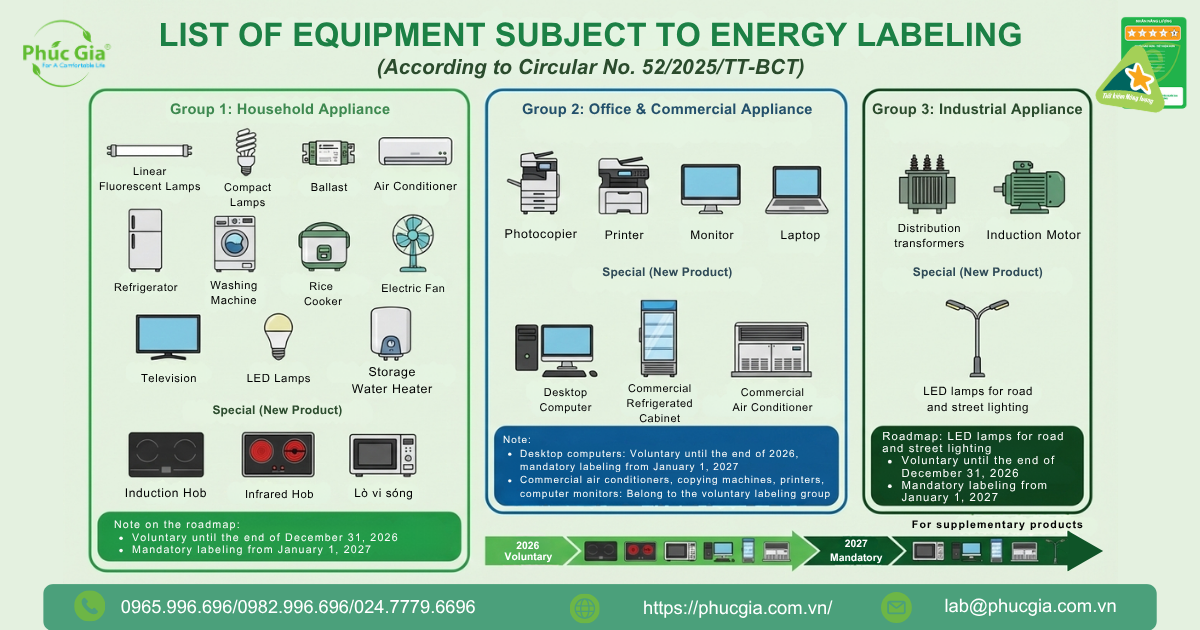
On June 18, 2025, the National Assembly promulgated the Law amending and supplementing several articles of the Law on Economical and Efficient Use of Energy, effective from January 01, 2026. Along with that, the Ministry of Industry and Trade issued Circular No. 52/2025/TT-BCT, stipulating the list of vehicles and equipment subject to energy labeling and the implementation roadmap from January 01, 2026.
New regulations not only tighten management for familiar devices but also expand the scope of application to construction materials, ducted air conditioners, commercial refrigerators, etc., accompanied by a specific application roadmap. This expansion shows an orientation to shift from encouragement to mandatory application of energy efficiency requirements for energy-consuming products, rather than being limited to a few equipment groups as before.
2. Multi-layered benefits of the “Energy Card”
An energy label is a label affixed to electrical equipment providing information on consumption levels and energy efficiency, helping users evaluate electricity-saving capabilities and choose appropriate products. Currently, in Vietnam, there are three main types of energy labels:
- The confirmation energy label, showing that the device has met energy efficiency standards;
- The comparative energy label, allowing consumers to compare electricity consumption between products of the same type;
- The highest energy efficiency label, intended for devices reaching optimal efficiency levels, encouraging enterprises to upgrade technology and improve designs.

For consumers, an energy label acts as a “quick information board” helping to compare electricity consumption among devices of the same type. Instead of having to research too many technical specifications, buyers can rely on the label to select products better suited to their needs and power cost-saving potential during operation. This is particularly useful for daily product groups such as air conditioners, refrigerators, washing machines, electric fans, or LED lamps…
The implementation of energy labeling also creates positive competition for enterprises. As customers become increasingly concerned with electricity consumption and operational efficiency, manufacturers are forced to invest in research, improve designs, upgrade production lines, and develop new technologies to meet market requirements and legal regulations.

Energy labeling is not just an “information stamp” for buyers but also a tool to drive innovation. Obsolete technology products with high energy consumption will be gradually phased out, while high-efficiency products will have better competitive opportunities. This not only reduces pressure on the national power system and ensures energy security but also directly achieves Emission Reduction, contributing to building a green, sustainable consumer economy and protecting the living environment for future generations.
3. Updating the list of vehicles and equipment subject to energy labeling
Circular No. 52/2025/TT-BCT adds many products to the list of vehicles and equipment subject to energy labeling, such as:
- Household equipment group: Adding induction hobs, infrared hobs, and microwave ovens;
- Office and commercial equipment group: Adding desktop computers, commercial refrigerators, and commercial air conditioners;
- Industrial equipment group: Adding LED lamps for road and street lighting.
For new products, the application roadmap allows voluntary labeling until the end of December 31, 2026, then shifting to mandatory from January 01, 2027, creating preparation time for enterprises. The Circular also encourages voluntary labeling for products not yet on the list but which already have national standards on energy efficiency and domestic testing capabilities.
4. Strategic vision towards Net Zero
Vietnam’s energy efficiency management program has currently developed more than 50 sets of national standards, applied to 19 key equipment categories, creating a foundation for achieving carbon neutrality goals and a sustainable green economy.
Energy labeling is not only a legal requirement but also represents the prestige of the enterprise, while helping consumers easily choose electricity-saving devices. When high-efficiency equipment is widely used, pressure on the national power system decreases, and greenhouse gas volumes are also cut. This is one of the practical solutions to realize sustainable development goals and transition to a green growth model.

RELATED POSTS
- Decision No. 1725/QĐ-BCT on Promulgating the List of Goods for Energy Efficiency Inspection and Energy Labeling Under the Management Responsibility of the Ministry of Industry and Trade
- Circular No. 38/2025/TT-BCT Amending Regulations on Decentralization of Administrative Procedures in Fields Under the Management Scope of the Ministry of Industry and Trade
- Decree No. 139/2025/NĐ-CP Regulating the Delineation of Authority of Two-Level Local Governments in the Field of State Management of the Ministry of Industry and Trade
- The Government Issued 28 Decrees on Decentralization, Power Delegation, and Delineation of Authority for Two-Level Local Governments
- Circular No. 07/2025/TT-BKHCN Regulating Decentralization and Delineation of Authority
- Circular No. 52/2025/TT-BCT – Regulating the List of Vehicles and Equipment Subject to Energy Labeling
For more details, please contact us at:
PHUC GIA LABORATORY CORPORATION
PHUC GIA CERTIFICATION CENTER
PHUC GIA INSPECTION TESTING CENTER
Address:
- Hanoi: ICD Long Bien, No. 01 Huynh Tan Phat, Sai Dong B Industrial Park, Long Bien Ward
- Ho Chi Minh City: No. 180, D2 Street, Long Truong Ward
Hotline: 0965996696 / 0982996696 / 02477796696
E-mail: lab@phucgia.com.vn/cert@phucgia.com.vn/info@phucgia.com.vn
Website: phucgia.com.vn
Working time: Monday to Friday 8:00 – 18:30; Saturday 8:00 – 12:00

![QUOTATION – Testing and Other Certification Services [2026]](https://phucgia.com.vn/wp-content/uploads/2017/03/bao-gia-thu-nghiem-chung-nhan.png)