

From January 1, 2026, all surveillance camera equipment using Internet Protocol (IP Cameras) manufactured domestically or imported must meet the requirements of QCVN 135:2024/BTTTT before being permitted for circulation on the market. In addition to technical requirements for information security, Product Labeling for IP Cameras must also comply with current regulations and ensure consistency with the technical information of the device.
See more: Capacity Profile Of Phuc Gia Laboratory Corporation
I. What is a product label?
A product label is a written, printed, drawn, or photographed copy of words, drawings, images, or data carriers that are pasted, printed, attached, molded, carved, engraved, affixed, or displayed directly on the product, the commercial packaging of the product, or on other methods attached to the product or the commercial packaging of the product (based on Article 3, Decree No. 37/2026/NĐ-CP).
In addition, some terms related to product labels are defined as follows:
-
The original label of product is the label first displayed on the product or the commercial packaging of the product.
-
The supplementary label of product is a label showing mandatory contents translated from the foreign-language original label into Vietnamese and adding mandatory Vietnamese contents required by Vietnamese law that are missing from the original label.
-
A physical label is a product label in physical form, including written, printed, drawn, or photographed copies of words, drawings, or images, which are pasted, printed, attached, molded, carved, or engraved directly on the product, the commercial packaging of the product, or on other materials attached to the product or the commercial packaging of the product.
-
An electronic label is a product label in electronic form displayed through a data carrier that is pasted, printed, attached, molded, carved, engraved, affixed, or displayed directly on the product or the commercial packaging of the product (e.g., QR codes, NFC Chips, Barcodes, etc.).

II. The role of product labels in the management and assessment of IP Cameras
In addition to technical and security feature requirements, the content displayed on product labels serves not only for product identification but also provides basic information such as the device model, origin, the responsible entity, and technical specifications. These are essential data points so that management agencies, conformity assessment organizations, and users can determine the origin of the equipment being used.
The labels of IP Cameras are among the contents inspected from the very first step. Incorrect, incomplete, or inconsistent Product Labeling for IP Cameras compared to technical dossiers, IXIT documents, or information displayed on the device interface can prolong the time and incur additional costs during the testing and certification process.

III. Regulations on Product Labeling for IP Cameras
1. Mandatory contents on product labels
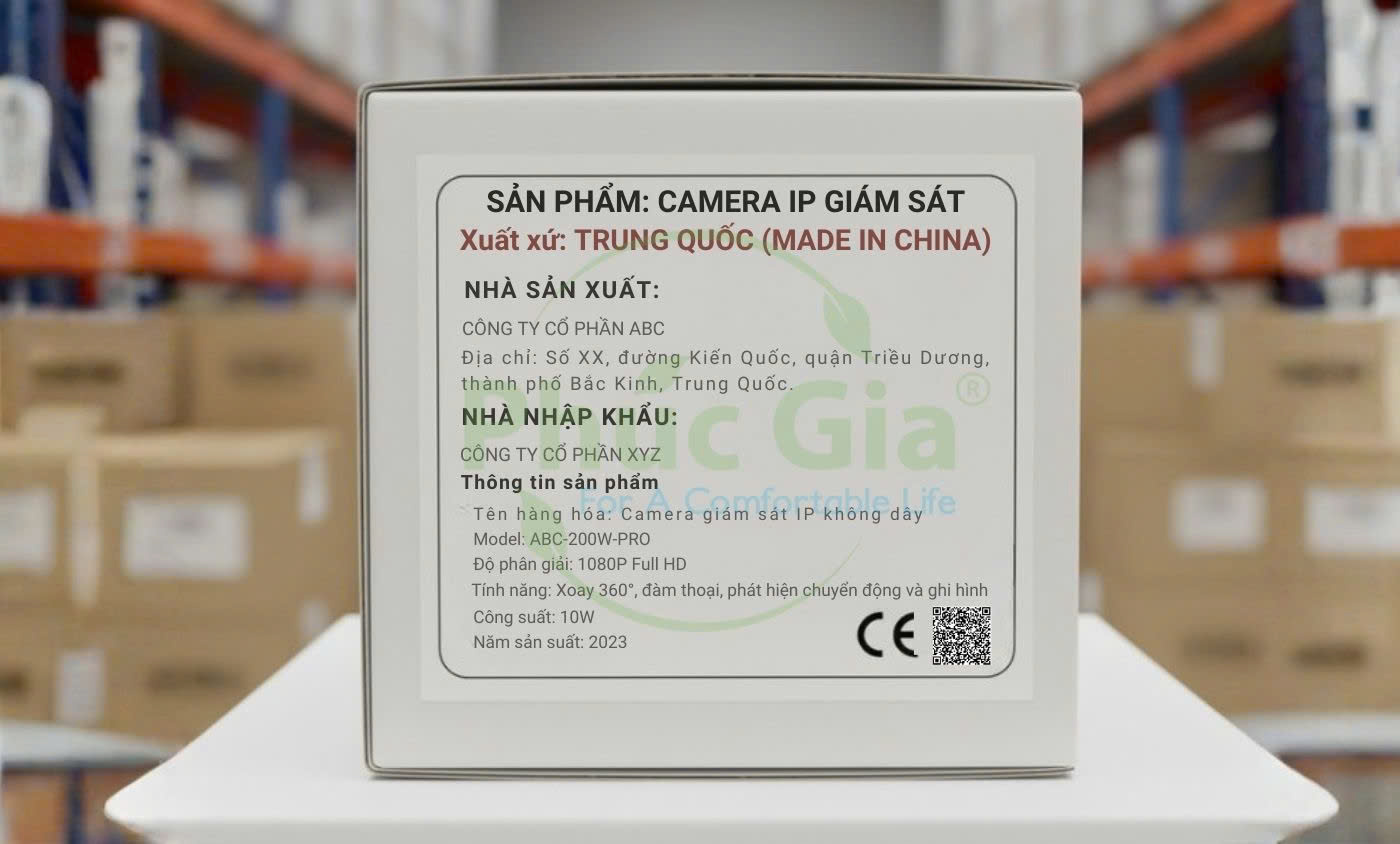
IP Cameras belong to Group 40 (telecommunications, information technology, electrical, and electronic equipment) as prescribed in Decree No. 37/2026/NĐ-CP – “Providing detailed regulations on a number of articles and measures to organize and guide the implementation of the Law on Quality of Products and product.” Accordingly, product labels circulated on the Vietnamese market must mandatory display information in Vietnamese, including:
-
Name of product (Example: IP Camera, Surveillance Camera…);
-
Name and address of the organization or individual responsible for the product (manufacturer, importer/distributor);
-
Origin of product (or the location where the final finishing stage was performed);
-
Year of manufacture;
-
Basic technical specifications (e.g., Power supply, Capacity, MAC address, Resolution, IP rating if installed outdoors…);
-
Safety warning information;
-
Instructions for use and storage instructions.
Note:
-
If it is a refurbished or renewed information technology product, the phrase “refurbished product” must be clearly stated.
-
Long contents such as technical specifications, instructions for use, security vulnerability policies, or update support periods can be encoded and integrated via electronic labels (QR Code) to optimize packaging space.
2. Requirements for product labels according to QCVN 135:2024/BTTTT
In addition to general regulations on product labels, IP Camera equipment must meet the requirements for product labels according to QCVN 135:2024/BTTTT to ensure device identification capability and to publicize information related to information security.
2.1. Device identification label
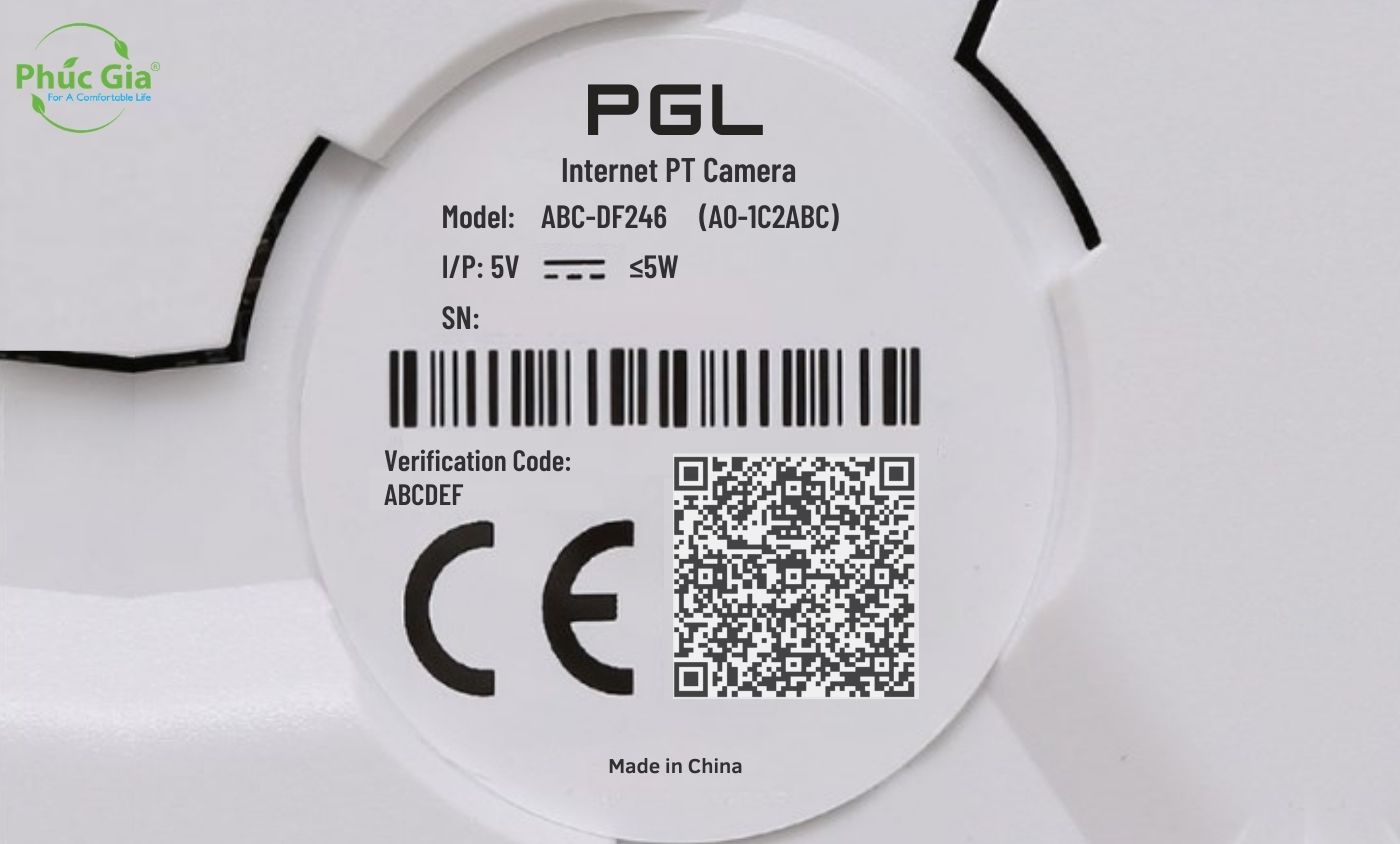
The camera equipment must mandatory allow users to look up information about the product code and type (Model) through a label attached directly to the device or through a physical interface. This is also a content reviewed by the testing laboratory during the evaluation process to determine whether the device model is clearly identified through the information shown on the label.
2.2. Mandatory publicized information
The manufacturer must publicize information related to the information security of the device, which can be shown on the label, packaging, or accompanying documents, including:
-
Security vulnerability disclosure policy, clearly stating contact information and the timeframe for reception and processing.
-
Warranty support period or software update period for each type of camera equipment for the user.
3. Requirements for the Original Label
If the IP Camera is imported, at the time of customs clearance procedures, the original label (which must be a physical label) must have at least 03 contents:
-
Name of product.
-
Origin of product.
-
Name (full or abbreviated) and address of the manufacturing organization, individual, or responsible entity abroad (if missing, it can be supplemented in the documents or shipment papers).
Note: For product imported into Vietnam with a foreign-language original label, the importing organization or individual must mandatory perform the addition of a product label written in Vietnamese (with all mandatory information as prescribed) before putting the product into circulation in the Vietnamese market.
4. Application of electronic labels (QR Codes, Chips…)
Enterprises must mandatory have physical labels for at least 4 pieces of information: Name of product, Name/address of the responsible organization, Origin, and Warning information. Long contents such as technical specifications, instructions for use, security vulnerability policies, or update support periods can be encoded into electronic labels (QR Codes) to optimize packaging space.
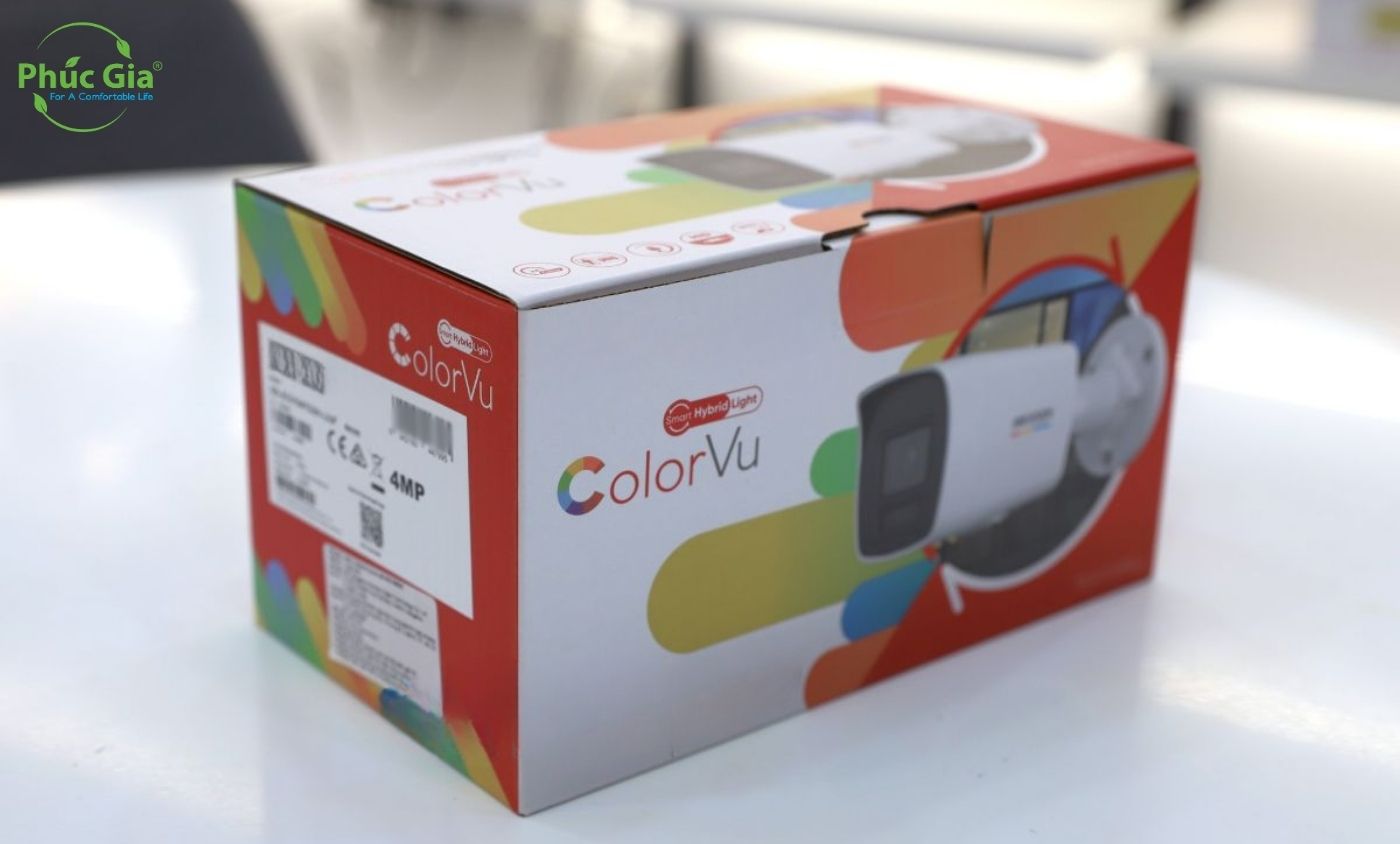
5. Requirements for letters and numbers on product labels
- The size of letters and numbers for mandatory contents must not be less than 0.9 mm so that they can be read by the naked eye.
- The colors of letters, numbers, and drawings on the label must be clear; letters and numbers must have a contrasting color to the background color of the label to be readable by the naked eye.
6. Language requirements on labels
Mandatory contents displayed on the labels of product circulated in the Vietnamese market must be written in Vietnamese, except for exported product not consumed domestically.
- Mandatory contents displayed on the labels of product circulated in the Vietnamese market must be written in Vietnamese, except for special cases (*) permitted by law.
- The proper names of organizations, individuals, and locations or the names of countries/territories that produced the product or where the final stage of the product was performed, recorded on the labels of product circulated in the Vietnamese market, must not be abbreviated (except for words indicating administrative units, which may be abbreviated).
- For product produced and circulated domestically, in addition to the mandatory Vietnamese content, enterprises may add other languages. However, the use of other languages must comply with the principles in Decree 37/2026/ND-CP (**).
- For imported product, in cases where the original label does not display or incompletely displays the mandatory contents in Vietnamese, the enterprise must supplement a supplementary label (***) and keep the original label of the product intact.
(*) Some contents are permitted to be presented in languages with Latin-based scripts in the following cases:
-
International names or scientific names when there is no Vietnamese name;
-
International names or scientific names accompanied by chemical formulas, structural formulas of chemicals, active ingredients, excipients, and components of drugs;
-
International names or scientific names of ingredients or quantitative ingredients of product in cases where they cannot be translated into Vietnamese or can be translated into Vietnamese but have no meaning;
-
Names and addresses of foreign enterprises;
-
International names of countries or territories that cannot be transliterated into Vietnamese or for which transliteration has no meaning;
-
Names of cultural and artistic products, names of authors, and artistic troupes.
(**) The use of other languages must comply with the principles: The content in other languages is not required to be a full translation of the Vietnamese, must not contradict or distort the Vietnamese content, and must not cause misunderstanding about the nature, utility, or origin of the product; the font size of the other language must not be larger than the font size of the Vietnamese.
(***) Supplementary labels must ensure:
-
Fully displaying mandatory contents in Vietnamese; the content corresponds to the information on the original label and does not change or distort the content of the original label.
-
The supplementary label must be attached to the product or the commercial packaging of the product and must not obscure the mandatory contents of the original label as prescribed by Vietnamese law.
-
The supplementary label may be presented as an electronic label as prescribed in Decree 37/2026/ND-CP.
7. Requirements for labeling position
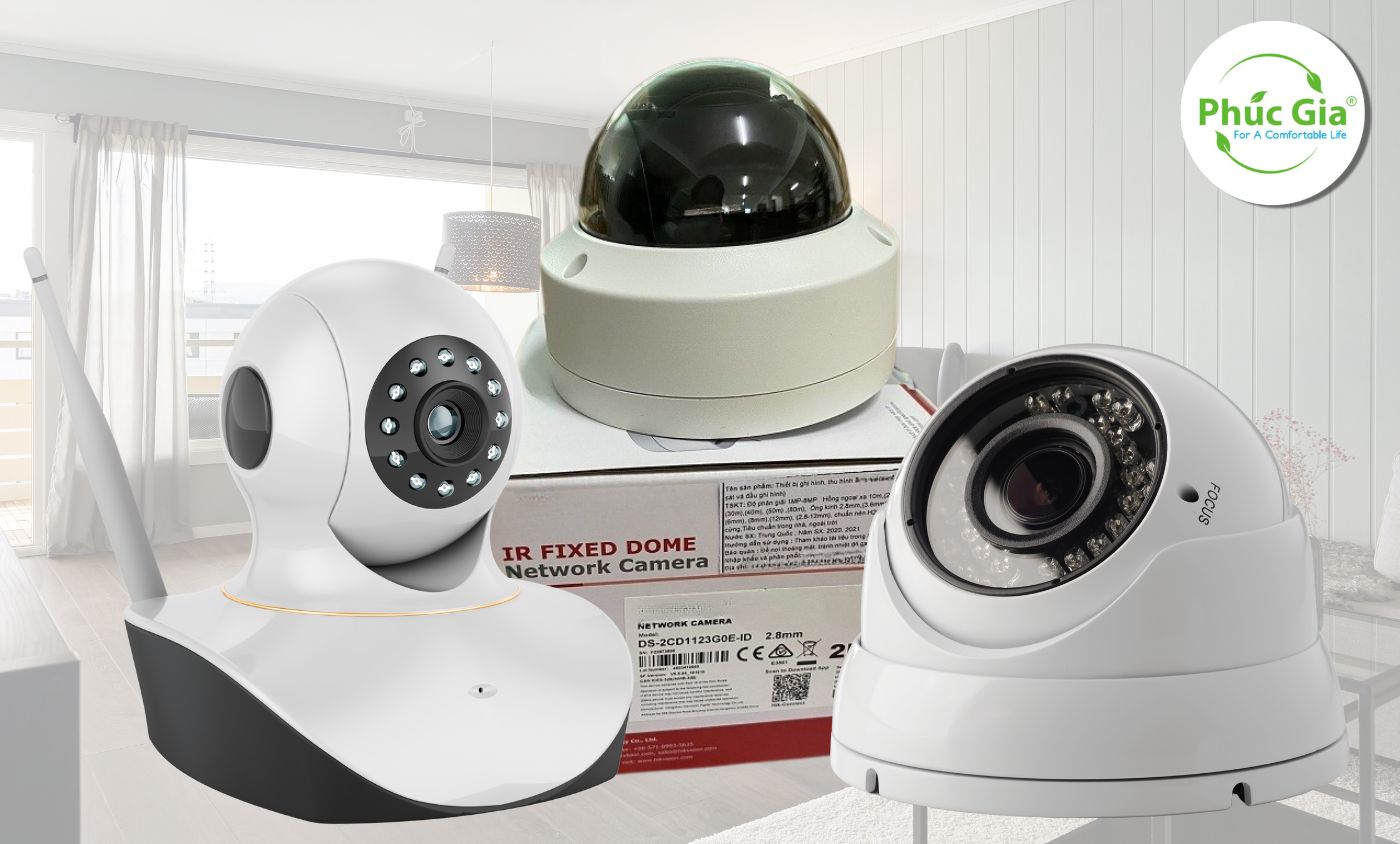
Labels must be attached in a position where all mandatory contents can be easily observed without needing to disassemble the components of the IP Camera. In the event that the conformity mark (CR) is shown on the label, the arrangement must ensure that it does not obscure or distort other mandatory contents on the product label.
IV. Contents that enterprises need to note before bringing products to market
Enterprises need to review a number of contents related to product labels, technical dossiers, and quality management procedures before bringing products to market.
-
Review label designs and technical documents: Enterprises need to ensure that the content recorded on labels, packaging, and technical documents of the product is consistent, clear, and accurate.
-
Finalize product labels according to regulations: In cases where the original label of imported product does not fully display mandatory content in Vietnamese, the enterprise must add a supplementary label before bringing the product to market and may only attach the conformity mark (CR) after the product has been certified for conformity.
-
Application of electronic labels: Enterprises can use technologies such as QR codes, Barcodes, or electronic data carriers (RFID, NFC) to provide additional information about the product.
-
Ensure accessibility of electronic label information: If using electronic labels, enterprises need to ensure that users can access the information directly and maintain this accessibility throughout the product lifecycle.
-
Conformity Mark (CR): IP Cameras within the scope of QCVN 135:2024/BTTTT must perform conformity certification and conformity announcement. After achieving certification of compliance with technical regulations, the product must be affixed with the Conformity Mark (CR) on the label or packaging before circulation (Note: The conformity mark is permitted to be shown on the product label but must ensure not to obscure or distort other mandatory contents on the label).
-
Work with designated testing and certification units: Enterprises should communicate early with testing laboratories and certification organizations designated by management agencies to prepare test samples, technical dossiers, and plans for testing and certification before the regulation becomes mandatory.

Enterprises can refer to the certification process for IP Cameras according to QCVN 135:2024/BTTTT at Phuc Gia® to proactively prepare full dossiers, test samples, label designs, IXIT documents, and Firmware… ensuring the certification process takes place smoothly and quickly.
Phuc Gia Certification Center – Phuc Gia Laboratory Corporation (Phuc Gia®) is designated by the Ministry of Public Security (MPS) to perform certification activities for surveillance camera equipment using Internet Protocol (IP Cameras) in accordance with the National Technical Regulation QCVN 135:2024/BTTTT – Technical regulation on basic information security requirements for surveillance cameras using Internet Protocol.
RELATED POSTS
- Certification Process for IP Cameras Compliant with QCVN 135:2024/BTTTT
- 4 Factors Ensuring Information Security for IP Cameras in Vietnam
- What is an IP Camera? The Role of IP Cameras in Daily Life
- Which Surveillance Cameras Must Be Tested According to QCVN 135:2024/BTTTT?
- Information Security Management Status for Surveillance Cameras Worldwide and in Vietnam
- Impact of QCVN 135:2024/BTTTT on the IP Camera Market
- Ensuring Network Information Security for Surveillance Camera Systems
- Why Information Security Control is Necessary for Surveillance Cameras Using Internet Protocol
For more details, please contact us at:
PHUC GIA LABORATORY CORPORATION
PHUC GIA CERTIFICATION CENTER
PHUC GIA INSPECTION TESTING CENTER
Address:
- Hanoi: ICD Long Bien, No. 01 Huynh Tan Phat, Sai Dong B Industrial Park, Long Bien Ward
- Ho Chi Minh City: No. 180, D2 Street, Long Truong Ward
Hotline: 0965996696 / 0982996696 / 02477796696
E-mail: lab@phucgia.com.vn/cert@phucgia.com.vn/info@phucgia.com.vn
Website: phucgia.com.vn
Working time: Monday to Friday 8:00 – 18:30; Saturday 8:00 – 12:00

![QUOTATION – Testing and Other Certification Services [2026]](https://phucgia.com.vn/wp-content/uploads/2017/03/bao-gia-thu-nghiem-chung-nhan.png)