I. The Situation of Radio Access Equipment Usage in Vietnam 5 GHz band radio access equipment (such as Access Points and Wi-Fi Routers) has become an indispensable part of the Internet network infrastructure in Vietnam, especially in urban areas. While the 2.4 GHz band frequently faces interference, the 5 GHz band provides higher speeds and better stability for users.
Currently, most modern organizations, enterprises, and households use dual-band or tri-band Wi-Fi devices that support 5 GHz to meet high-volume data transmission needs, such as high-resolution video streaming (4K video), online meetings, gaming, and real-time applications. This demonstrates the growing role of 5 GHz RLAN/WAS devices within internal connectivity systems.
Along with the sharp increase in usage, management requirements have also been tightened. According to Circular No. 29/2025/TT-BKHCN EIRP of 60 mW or higher belongs to the List of Group 2 Products, making it mandatory to undergo Testing for Radio Access Equipment in Vietnam according to QCVN 65:2021/BTTTT and perform a declaration of conformity before market distribution.
Testing for Radio Access Equipment in Vietnam according to QCVN 65:2021/BTTTT is a critical step to assess the ability to meet emission limits, EIRP levels, and safe operating conditions within the 5 GHz band. Manufacturing and importing enterprises must ensure products comply with regulations before circulation, especially when equipment has a power level of 60 mW or higher.
II. Guidance on Testing for Radio Access Equipment in Vietnam According to QCVN 65:2021/BTTTT 1. Scope of Application Devices with integrated 5 GHz band radio access functions and an emission power (EIRP ) of 60 mW or higher—such as mobile phones, desktop computers, tablets, laptops, televisions, flycams, or UAV/Drones—must undergo Testing for Radio Access Equipment in Vietnam according to QCVN 65:2021/BTTTT when operating in all or some of the frequency bands specified in the following table:
Table – Operating frequency ranges of 5 GHz band RLAN equipment
Function Frequency Band
Transmitting 5 150 MHz to 5 350 MHz
Receiving 5 150 MHz to 5 350 MHz
Transmitting 5 470 MHz to 5 850 MHz
Receiving 5 470 MHz to 5 850 MHz
Based on Circular No. 29/2025/TT-BKHCN QCVN 65:2021/BTTTT when they fall under one of the following HS codes:
ORD Product Name HS Code According to Circular No. 31/2022/TT-BTC Product Description
1 5 GHz band radio access equipment with an Effective Isotropic Radiated Power (EIRP) of 60 mW or higher 8517.62.51
Wi-Fi transceiver equipment (Wi-Fi Modem, Wi-Fi transmitter) used in wireless local area networks (WLAN) in the 5 GHz band (frequency band including 3 sub-bands: 5150 MHz to 5350 MHz, 5470 MHz to 5725 MHz, and 5725 MHz to 5850 MHz) with an Effective Isotropic Radiated Power (EIRP ) of 60 mW or higher, with or without one or more of the following integrated functions:
– Broadband data transmission operating in the 2.4 GHz band;
– Terrestrial mobile communication terminal;
– Fifth generation (5G) mobile communication terminal;
– Other short-range radio transceivers.
2 8806.21.00 8806.22.00 8806.23.00 8806.24.00 8806.29.00 Flycam (television cameras, digital cameras, and video cameras mounted on flying devices) using remote control technology, transmitting images by spread-spectrum modulated radio waves in the 5 GHz band (frequency band including 3 sub-bands: 5150 MHz to 5350 MHz, 5470 MHz to 5725 MHz, and 5725 MHz to 5850 MHz) and having an Effective Isotropic Radiated Power (EIRP) from 60 mW to 200 mW.
3 8806.21.00 8806.22.00 8806.23.00 8806.24.00 8806.29.00 UAV/Drone (remotely controlled aircraft, which may integrate television cameras, digital cameras, and video cameras) using remote control technology, transmitting images by spread-spectrum modulated radio waves in the 5 GHz band (frequency band including 3 sub-bands: 5150 MHz to 5350 MHz, 5470 MHz to 5725 MHz, and 5725 MHz to 5850 MHz) and having an Effective Isotropic Radiated Power (EIRP) from 60 mW to 200 mW.
2. Technical Requirements QCVN 65:2021/BTTTT stipulates requirements for bandwidth access to efficiently share bandwidth resources and limit the risk of interference with other radio systems. In the context of the increasing demand for 5 GHz band connectivity, Testing for Radio Access Equipment in Vietnam according to QCVN 65:2021/BTTTT helps assess the ability of equipment to meet technical requirements before being circulated on the market.
Accordingly, wireless local area network equipment (5 GHz band RLAN equipment) capable of operating in all or some of the frequency bands specified in this regulation must meet technical requirements regarding:
(1) Nominal Center Frequency: RLAN equipment usually operates on one or several fixed frequencies. The equipment is allowed to change its nominal operating frequency in case interference is detected or to avoid causing interference to other equipment and to meet the requirements of frequency planning;
(2) Nominal Channel Bandwidth and Occupied Channel Bandwidth: When the equipment transmits on multiple adjacent channels, the transmitted signal can be considered as from one channel with a nominal channel bandwidth equal to “n” times the individual nominal channel bandwidth, where “n” is the number of consecutive adjacent channels. When the equipment transmits on multiple non-adjacent channels, each used channel is required to comply with the regulations;
(3) RF Output Power, Transmit Power Control (TPC), and Power Density: The limits in the regulation may apply across the entire system and in any configuration, taking into account the antenna gain of the integrated antenna or dedicated antenna as well as additional gain (beamforming) in the case of smart antenna systems. The total RF output power of all channels within that component band must not exceed the limits defined in Table 2 and Table 3 of QCVN 65:2021/BTTTT;
(4) Transmitter Unwanted Emissions: The level of unwanted emissions outside the 5 GHz RLAN band must not exceed the levels specified in Table 4 of this regulation;
(5) Transmitter Unwanted Emissions within the 5 GHz RLAN Band: The band includes frequency ranges from 5 150 MHz to 5 350 MHz and from 5 470 MHz to 5 850 MHz. The power density (determined over a 1 MHz bandwidth) of the transmitter’s unwanted emissions within the 5 GHz RLAN band must not be greater than -30 dBm/MHz and the limit level determined by the spectrum mask in Figure 1 according to this regulation.
Figure 1 – Emission Spectrum Mask (6) Receiver Spurious Emissions: Emissions on any frequency when the equipment is in receive mode; receiver spurious emissions must not exceed the limits specified in Table 5 of QCVN 65:2021/BTTTT ;
(7) Dynamic Frequency Selection (DFS): The mechanism used by the equipment to automatically limit transmission and perform access to the operating channel. The DFS function is described under conditions where the equipment can transmit; transmission is allowed provided it is not prohibited by adaptivity functional requirements. There are two types of adaptive equipment: Frame-Based Equipment (FBE) and Load-Based Equipment (LBE);
(8) Receiver Blocking Characteristics: Receiver blocking is the equipment’s ability to receive a desired signal on the operating channel with a guaranteed quality level in the presence of unwanted signals (blocking signals) at the input at frequencies outside the bands specified in Table 1 of QCVN 65:2021/BTTTT . Quality is assessed via the Packet Error Rate (PER) with a limit of 10%. In special cases for other purposes, the manufacturer must declare the specific quality limit to be used.
Note:
Circular No. 29/2025/TT-BKHCN stipulates the suspension of technical requirements under extreme/critical conditions from July 1, 2025, until the end of December 15, 2026 , for products and goods that are not Wi-Fi transceiver equipment (Wi-Fi Modems, Wi-Fi transmitters), HS code 8517.62.51, with integrated Wi-Fi functions. The technical requirements of this Regulation apply within the environmental operating conditions of the equipment as declared by the manufacturer. The equipment must comply with all technical requirements of this regulation when operating within the boundary limits of the declared operating environmental conditions.
3. Testing Costs and Duration Testing costs and lead times for radio access equipment according to QCVN 65:2021/BTTTT are publicly listed by Phúc Gia®. You can view the testing price list for electrical-electronic, telecommunications, and information technology equipment at our Quotation for Testing – Certification Services
4. Where to conduct Testing for Radio Access Equipment in Vietnam according to QCVN 65:2021/BTTTT? 4.1. Regulations on Qualified Testing – Certification Units Based on Article 5 of Consolidated Document No. 02/2020/VBHN-BTTTT – Regulations on conformity certification and declaration of conformity for specialized information technology and communications products and goods, the testing units serving certification and declaration of conformity are regulated as follows:
The testing unit serving conformity certification activities must be a designated or recognized testing unit.
The testing unit serving conformity declaration activities must be a designated or recognized testing unit, or a unit that has registered testing activities under Decree No. 107/2016/NĐ-CP
Testing units are responsible before the Competent Authority for the accuracy of measurement and testing results. Measurement/testing results do not serve as a replacement for the Certificate of Conformity or the Declaration of Conformity.
Circular No. 29/2025/TT-BKHCN “Measurement/testing results from domestic or foreign laboratories that have not been designated or recognized, or measurement/testing results from manufacturers, shall not be used to assess conformity with this technical regulation.”
4.2. Phuc Gia® – A Reputable Testing Organization for Telecommunications and Information Technology Equipment in Vietnam
Phuc Gia Laboratory Corporation (Phuc Gia®) is designated by the Ministry of Science and Technology to perform Testing for Radio Access Equipment in Vietnam and other IT/telecom equipment according to 24 Vietnamese Technical Regulations. This serves the quality management of potentially unsafe products under the Ministry’s responsibility as per Decision No. 2899/QĐ-BKHCN Decision No. 228/QĐ-BTTTT
Accordingly, Phuc Gia® is designated to perform Testing for Radio Access Equipment in Vietnam for 5 GHz band radio access equipment with an Effective Isotropic Radiated Power (EIRP ) from 60 mW—such as mobile phones, desktop computers, tablets, laptops, smartwatches, Wi-Fi devices, Flycams, UAVs/Drones, etc.—according to QCVN 65:2021/BTTTT .
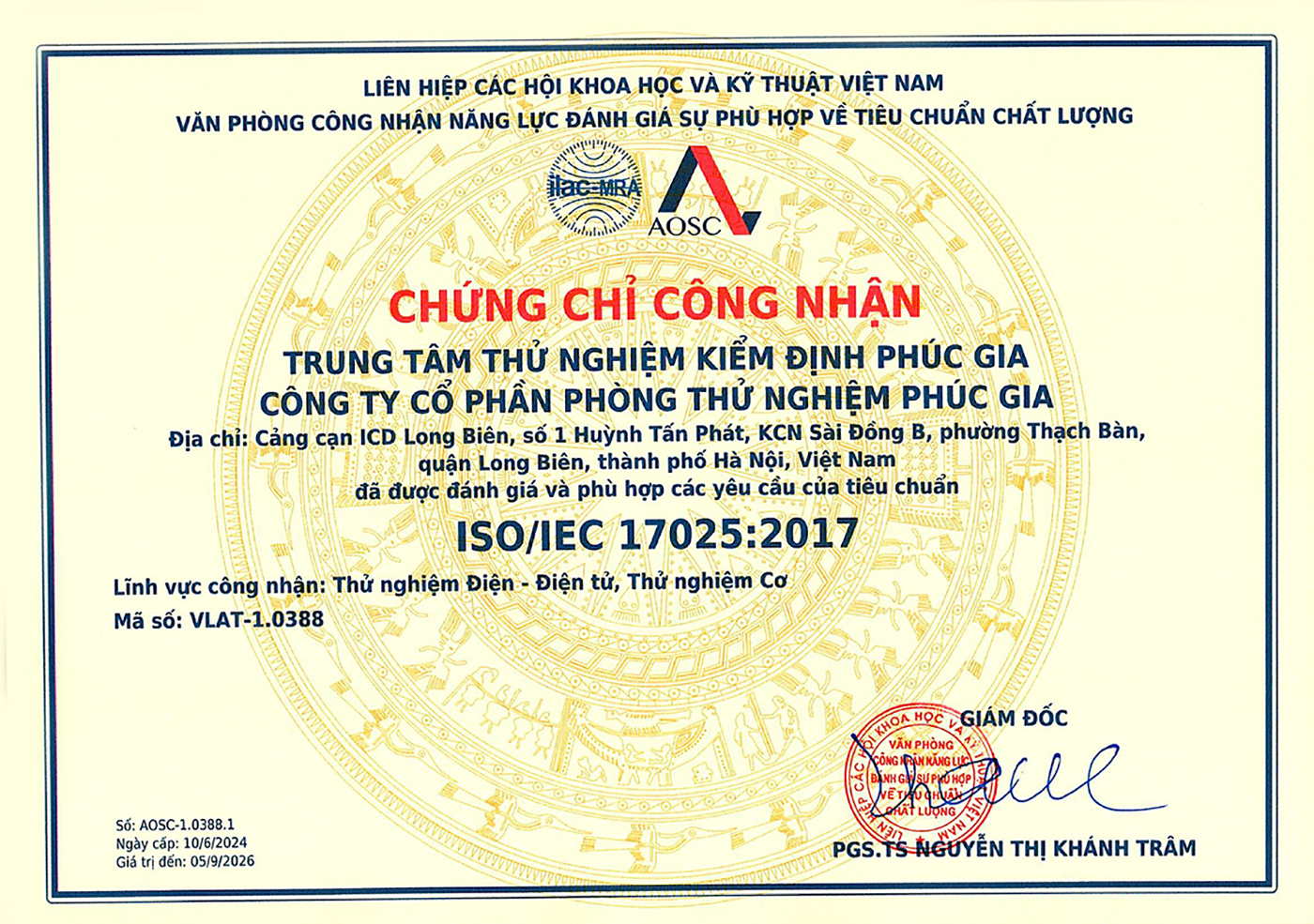
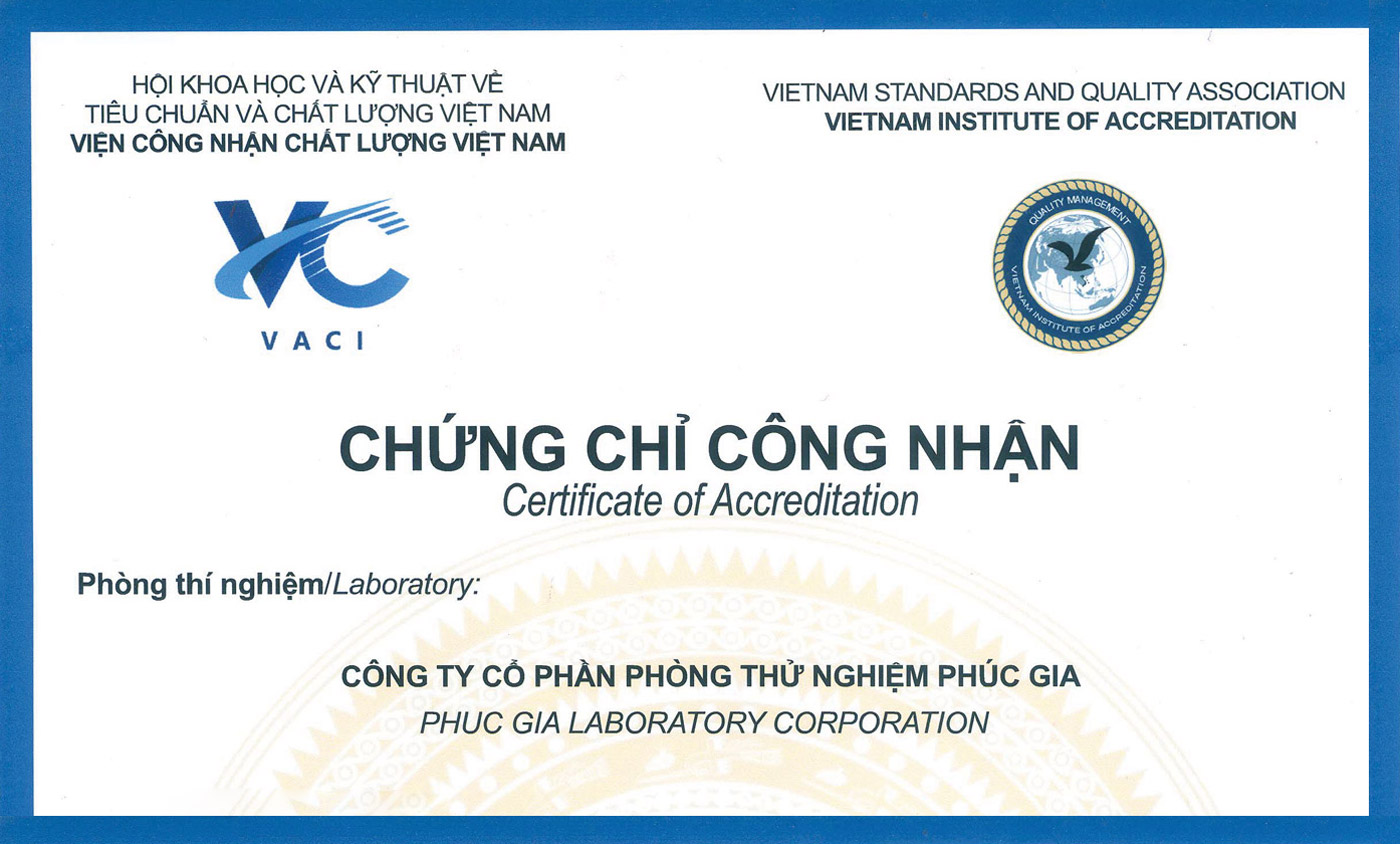
Phúc Gia® is also the first unit to be accredited by all three accreditation bodies (BoA, AOSC, VACI ) as meeting ISO/IEC 17025:2017 standards. Our testing facility spans 5,000 m², equipped with modern measurement and inspection systems for electrical safety, EMC, energy efficiency, RF, SAR, and many other technical categories.
Complementing this is a team of nearly 100 officers, engineers, and technical experts who are meticulously selected and intensively trained to meet the stringent requirements of testing, certification, and conformity assessment across multiple technical fields.
ICT Testing Chamber – Phuc Gia Laboratory Corporation Control Room – Phuc Gia Laboratory Corporation Phuc Gia Certification Center R ELATED POSTS
For more details, please contact us at:
PHUC GIA LABORATORY CORPORATION
PHUC GIA CERTIFICATION CENTER
PHUC GIA INSPECTION TESTING CENTER
Address:
Hotline: 0965996696 / 0982996696 / 02477796696
E-mail: lab@phucgia.com.vn /cert@phucgia.com.vn /info@phucgia.com.vn
Website: phucgia.com.vn
Working time: Monday to Friday 8:00 – 18:30; Saturday 8:00 – 12:00



![QUOTATION – Testing and Other Certification Services [2026]](https://phucgia.com.vn/wp-content/uploads/2017/03/bao-gia-thu-nghiem-chung-nhan.png)