

AC Import procedures include important steps such as preparing legal documents, opening the customs declaration, registering for quality inspection, and taking samples for testing. This process requires enterprises to be knowledgeable about procedures as well as laws to ensure the import of air conditioners takes place in a timely manner. Therefore, in the article below, Phuc Gia will help you better understand the above process.
See more: Capacity Profile Of Phuc Gia Laboratory Corporation
An Air Conditioner (AC) is a device that adjusts temperature, humidity, and air quality in enclosed spaces (homes, offices, factories). The device operates according to a closed-loop refrigeration cycle with core components including: compressor, outdoor unit, indoor unit, and refrigerant.
As the power and efficiency of air conditioners directly affect power consumption, enterprises today pay great attention to AC Import regulations and procedures to ensure the equipment correctly meets technical and energy standards in Vietnam.
Air conditioners include many different types; below are some common ways to classify air conditioners:
- By structure: Single-unit, split-system (2 units), multi-split (3 or more units)
- By technology: Inverter, Non-Inverter
- By intended use: Residential, commercial, industrial
- By installation type: Wall-mounted, ceiling-mounted, floor-standing, central

1. AC Import Procedures
Clearly understanding each step in the process will help optimize time and costs for the enterprise, while avoiding issues arising during the import process. Below are the detailed steps in the AC Import procedures that enterprises need to note.
Step 1: Registration for Quality Inspection
Enterprises need to perform State control registration (on quality of products) for air conditioner (AC) products. The registration dossier includes:
- The set of import-export documents (Commercial Invoice, AWB or B/L, P/O or contract).
- Catalogue or datasheet of the product.
- Application form for quality inspection of air conditioners.
- Information on standards or technical regulations applied to the product.
After submitting the dossier, the Regulatory Authority will conduct product quality inspection according to the corresponding National Technical Regulations (QCVN).
Step 2: Opening the Customs Declaration
Enterprises need to prepare a full set of customs documents (contract, invoice, packing list, bill of lading, C/O, arrival notice, HS code) before carrying out the customs declaration on the system. The declaration must be accurate, as errors regarding tax, HS code, or origin may lead to penalties. The declaration deadline is 30 days from the arrival of the goods at the port; after the declaration is completed, the declaration must be opened within 15 days.
Then, the system will perform lane classification: green (immediate Customs Clearance), yellow (documentary check), red (physical cargo inspection).
Note: After receiving the official declaration, the enterprise should immediately contact the Customs Branch to implement the air conditioner import procedures. Delays in processing may lead to unnecessary risks, affecting the Customs Clearance progress.
Step 3: Testing and Certification of Technical Regulation Compliance
After the goods arrive at the port or airport, the enterprise needs to take samples for testing to check quality according to regulations, accompanied by a confirmation slip from the Testing laboratory. To determine that air conditioner products are legally circulated on the Vietnamese market, enterprises need to perform electromagnetic compatibility (EMC) testing according to QCVN 9:2012/BKHCN and Energy Efficiency testing. At the same time, complete the process of Certification of Conformity, Declaration of Technical regulation Compliance for air conditioners, affix the CR mark, and perform Energy labeling registration.
Currently, Phuc Gia has been designated by the Ministries to perform testing activities according to QCVN 9:2012/BKHCN, Amendment 1:2018 QCVN 9:2012/BKHCN, and Energy Efficiency testing, and is licensed for Certification of Conformity activities. With over 10 years of experience in testing and certification of electrical and electronic equipment, Phuc Gia commits to bringing customers the most reliable, accurate, objective, and cost-optimized services, while supporting enterprises in completing procedures and documents related to energy labeling and product Declaration of Technical regulation Compliance.
If the enterprise wishes to bring the entire shipment to a temporary warehouse for storage before results are available, they can contact Phuc Gia for procedural advice to avoid obstacles during Customs Clearance.
Step 4: Customs Clearance of the AC Import Declaration
After the customs officer completes the document check and finds no issues that need clarification, the declaration will be approved for Customs Clearance. At this point, the enterprise can fulfill the import tax obligation as prescribed to complete the Customs Clearance process.
In some special cases, the cargo may be released early so the enterprise can take the goods to a temporary warehouse for storage. After fully supplementing the missing documents, the customs authority will proceed with official Customs Clearance procedures.
In case the declaration has not been cleared, the enterprise needs to urgently complete the dossier and perform all required steps to achieve Customs Clearance. If allowed to exceed the time limit, the enterprise will not only be subject to administrative penalties but may also face difficulties in handling goods and take a long time to rectify the consequences.
Step 5: Bringing Goods to the Warehouse
After the declaration is cleared, the enterprise needs to perform procedures to liquidate the declaration and complete relevant steps to bring the goods to the warehouse. The AC Import process does not just stop at customs procedures but must simultaneously implement the quality inspection process as prescribed. Only when both tasks are fully combined is the import process considered complete.

2. Customs Dossier for AC Import
When performing an AC Import, enterprises need to prepare a full set of import-export documents as prescribed to help the Customs Clearance process take place in a timely manner. Some mandatory customs documents for AC Import include: Commercial Invoice, Bill of Lading, Letter of Introduction, and Certificate of Origin.
Below are the details of the mandatory document list and some supplementary documents that may be required depending on specific cases or regulations at each customs branch:
- Commercial Invoice – Copy provided by the enterprise. However, at some customs branches, the original is required if the shipment applies special preferential tax rates according to specific C/O forms (e.g., Form E).
- Bill of Lading – Copy presented by the enterprise.
- Letter of Introduction – Original required.
- Certificate of Origin (C/O) – Original or electronic version required if the importer requests special preferential import tax rates.
Depending on each case, the following documents may be requested:
- Packing List – Copy provided by the enterprise.
- Customs-Enterprise Partnership Development Agreement – Some branches require the original.
Other supplementary documents may include:
- Document confirming State control registration (on quality of products).
- Energy Efficiency Test Report regarding minimum Energy Efficiency, or an official letter confirming Energy labeling registration and labeling as prescribed.
3. Specialized Inspection Requirements for AC Import
Below are the specialized inspection requirements when performing AC Import procedures, helping enterprises clearly understand the regulations to be followed when importing goods:
| AC Type | Specialized Inspection | Note | |
| Quality inspection & Certification of Conformity (QCVN 9:2012/BKHCN and Amendment 1:2018 QCVN 9:2012/BKHCN) | Efficiency testing & Declaration of energy labeling (TCVN 7830:2015) | ||
| Unitary Air Conditioners (Window AC, Portable AC,…) | Yes | Yes |
TCVN 7830:2015 issued by the Ministry of Science and Technology in 2015 does not apply to Ducted Air Conditioner units, except for those with a rated cooling capacity of less than 8,000 W and designed to operate at an external static pressure of less than 25 Pa. Air conditioners with a capacity over 26.38 kW (90,000 BTU) or a current intensity > 25A do not require Certification of Conformity. Air conditioners using 3-phase electricity do not have to apply any specialized inspection policies. |
| Split Air Conditioner | Yes | Yes | |
| Multi-split systems with 3 or more units (Central, Multi Type) | Yes | No | |
4. Legal documents on AC Import
Below are the legal normative documents related to AC Import procedures:
- Decision No. 3810/QĐ-BKHCN dated December 18, 2019, of the Ministry of Science and Technology on the list of goods subject to quality inspection under the management of the Ministry of Science and Technology.
- Decision No. 1983/QĐ-TĐC dated October 15, 2014, of the Ministry of Science and Technology on issuing instructions for certification of conformity with national technical regulation QCVN 9:2012/BKHCN on electromagnetic compatibility (EMC) for household and similar electrical and electronic appliances.
- Circular No. 11/2012/TT-BKHCN dated April 12, 2012, of the Ministry of Science and Technology on issuing QCVN 9:2012/BKHCN. List of items to be tested according to QCVN 9:2012/BKHCN.
- Circular No. 07/2018/TT-BKHCN dated June 6, 2018, of the Ministry of Science and Technology on Amendment 1:2018 QCVN 9:2012/BKHCN – National Technical Regulation on electromagnetic compatibility for household and similar electrical and electronic appliances.
- Circular No. 01/2022/TT-BKHCN amending Circular No. 07/2018/TT-BKHCN and Circular No. 08/2019/TT-BKHCN issued by the Minister of the Ministry of Science and Technology on February 16, 2022.
- Circular No. 28/2012/TT-BKHCN issued on December 12, 2012, and 02/2017/BKHCN issued on March 31, 2017, stipulating the Declaration of Technical regulation Compliance and Conformity assessment methods for air conditioners.
- Decision No. 04/2017/QĐ-TTg dated March 9, 2017, of the Prime Minister stipulating the list of means and equipment subject to energy labeling, application of minimum energy efficiency levels, and the implementation roadmap.
- Decision No. 14/2023/QĐ-TTg dated May 24, 2023, of the Prime Minister issuing the list and roadmap of energy-using equipment to be discarded and low-efficiency power generating units not to be newly built.
- Circular No. 36/2016/TT-BCT dated December 28, 2016, of the Ministry of Industry and Trade stipulating energy labeling;
- Circular No. 30/2011/TT-BCT dated August 10, 2011, of the Ministry of Industry and Trade stipulating temporary regulations on the allowable content limits of certain toxic chemicals in electrical and electronic products.
- Consolidated Document of Circular No. 11/2012/TT-BKHCN issued on April 12, 2012, and No. 07/2018/TT-BKHCN issued on June 6, 2018, stipulating technical regulations applied to household electrical and electronic equipment such as air conditioners.
- Decision No. 1182/QĐ-BCT dated April 6, 2021, stipulating the list of specialized inspection products of the Ministry of Industry and Trade for air conditioners.
Based on the National Technical Regulations for air conditioner products with Wi-Fi functionality applied according to:
- Circular No. 02/2024/TT-BTTTT dated March 29, 2024, of the Ministry of Information and Communications stipulating the list of products and goods potentially causing unsafety under the management responsibility of MIC, replacing Circular No. 04/2018/TT-BTTTT.
- Circular No. 18/2017/TT-BTTTT dated September 11, 2017, of the Ministry of Information and Communications on the National technical regulation on electromagnetic compatibility for broadband radio data transmission equipment.
- Circular No. 35/2020/TT-BTTTT November 6, 2020, of the Ministry of Information and Communications stipulating the “National technical regulation on broadband data transmission equipment operating in the 2.4 GHz band”.
Other regulations include:
- Decree No. 74/2018/NĐ-CP issued on May 15, 2018, and effective from July 1, 2018, stipulating state quality inspection procedures (commonly applied to AC Import procedures).
- Decree No. 69/2018/NĐ-CP issued on May 15, 2018, effective from May 15, 2018, and Circular No. 08/2023/TT-BCT issued on March 31, 2023, effective from May 16, 2023, stipulating the list of used consumer goods prohibited from import.
Vietnam Standards (TCVN) include:
- TCVN 7830:2021 and TCVN 13256:2021 issued by the Ministry of Science and Technology (applied from January 1, 2025), stipulating new standards on Energy Efficiency and quality of air conditioners.
- Expected to be applied from 2026, there will be regulations on the content of toxic chemicals in air conditioner products.
5. HS code and tax when performing AC Import procedures
To ensure the AC Import process takes place in a timely manner, enterprises need to clearly understand relevant tax rates, including preferential import tax, ordinary import tax, and Value Added Tax (VAT). Accurately determining the HS code will help enterprises comply with the regulations of the customs authority and avoid unnecessary risks during Customs Clearance.
| HS Code | Description of goods | VAT (%) | Preferential import tax (%) | Ordinary import tax (%) |
| 8415 |
Air conditioning machines, comprising a motor-driven fan and elements for changing the temperature and humidity, including those machines in which the humidity cannot be separately regulated
|
|||
| 8415.10 |
Window or wall types, self-contained or “split-system” (fixed to a window, wall, ceiling, or floor)
|
|||
| 8415.10.20 | Cooling capacity ≤ 21.10 kW | 10% | 30% | 45% |
| 8415.10.30 | Cooling capacity > 21.10 kW to 26.38 kW | 10% | 30% | 45% |
| 8415.10.90 | Others in this group | 10% | 20% | 30% |
| 8415.81 |
Incorporating a refrigerating unit and a valve for reversal of the cooling/heat cycle (reversible heat pumps)
|
|||
| 8415.81.97 | Capacity ≤ 21.10 kW | 10% | 25% | 37.5% |
| 8415.81.98 | Capacity > 21.10 kW to 26.38 kW | 10% | 25% | 37.5% |
| 8415.81.99 | Others not in the two items above | 10% | 20% | 30% |
| 8415.82 | Other, incorporating a refrigerating unit | |||
| 8415.82.91 | Cooling capacity ≤ 26.38 kW | 10% | 27% | 40.5% |
| 8415.82.99 | Remaining products not in a specific sub-group | 10% | 15% | 22.5% |
6. What should be noted when performing AC Import?
When carrying out AC Import procedures, there are several important factors that enterprises need to note to ensure importation is timely and complies with legal regulations.
- Checking documents and Certification of Conformity: Before performing an AC Import, enterprises need to prepare a full set of procedural documents, including commercial invoices, transport documents, and certificates of product conformity. This helps verify that the product meets the technical and quality requirements prescribed by the Regulatory Authority.
- Checking energy labels: Air conditioners are items that require energy labeling. Ensure that the imported products have valid energy labels licensed through the correct process. Energy labeling helps consumers easily identify the power consumption level of the product, thereby selecting energy-saving products.
- Quality inspection: Air conditioner products must undergo quality inspection according to the regulations of the Ministry of Science and Technology. This includes testing for Energy Efficiency, durability, and operational capability to ensure product quality meets requirements.
- Taxes and fees for importation: Enterprises need to note the taxes and fees for AC Import, including Value Added Tax (VAT), preferential import tax, and ordinary import tax. The specific tax rate will depend on the product’s HS code, country of origin, and trade agreements between countries.
- Safety standard regulations: Air conditioners must comply with National Technical Regulations (QCVN) on electrical safety and electromagnetic compatibility requirements. Enterprises need to carefully check these requirements so that when products are imported into Vietnam, they do not violate safety regulations.

If you need support in performing AC Import procedures, please contact Phuc Gia® — a reputable unit with over 10 years of experience providing testing services, Certification of Conformity, and support for import dossier issues.
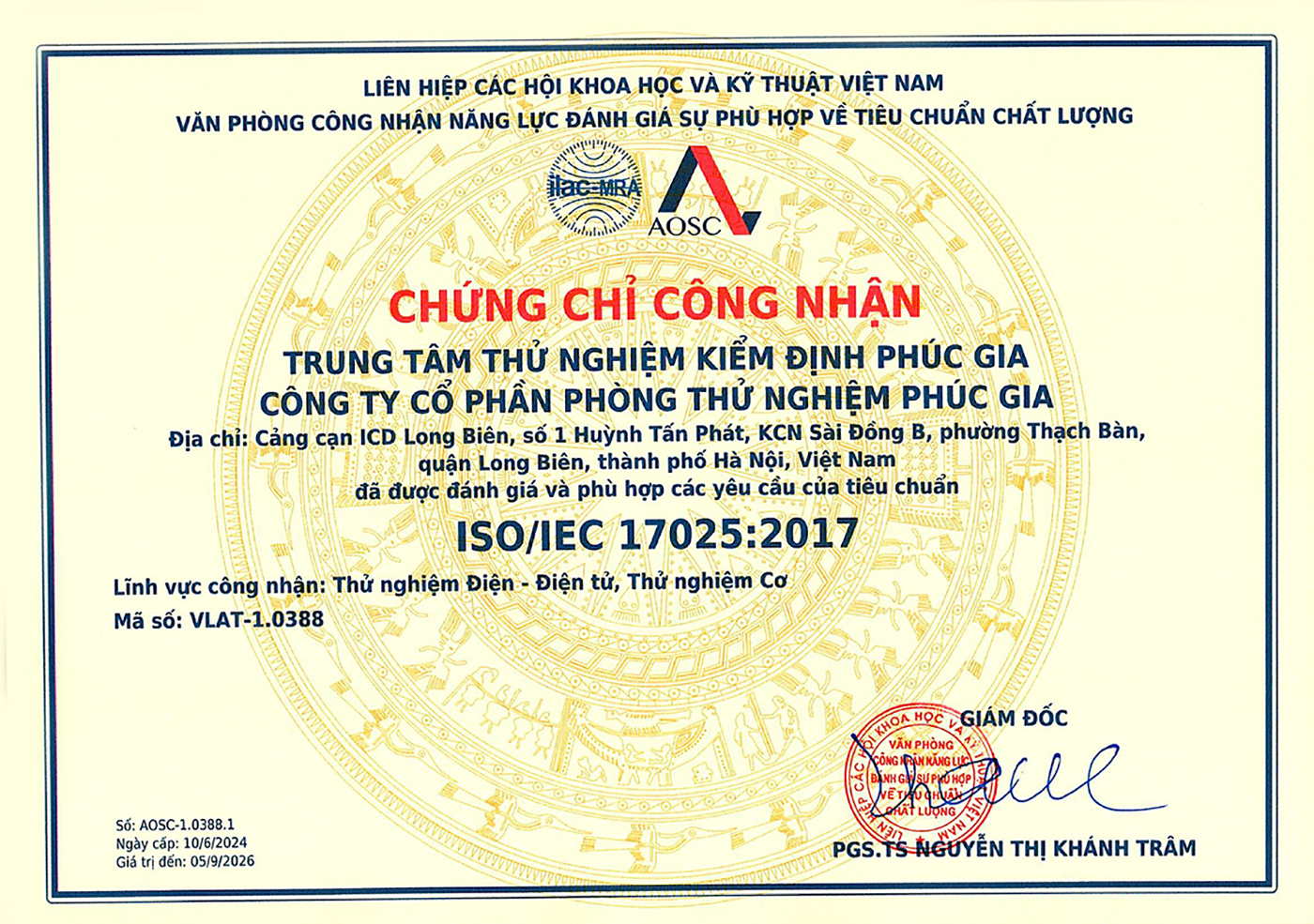
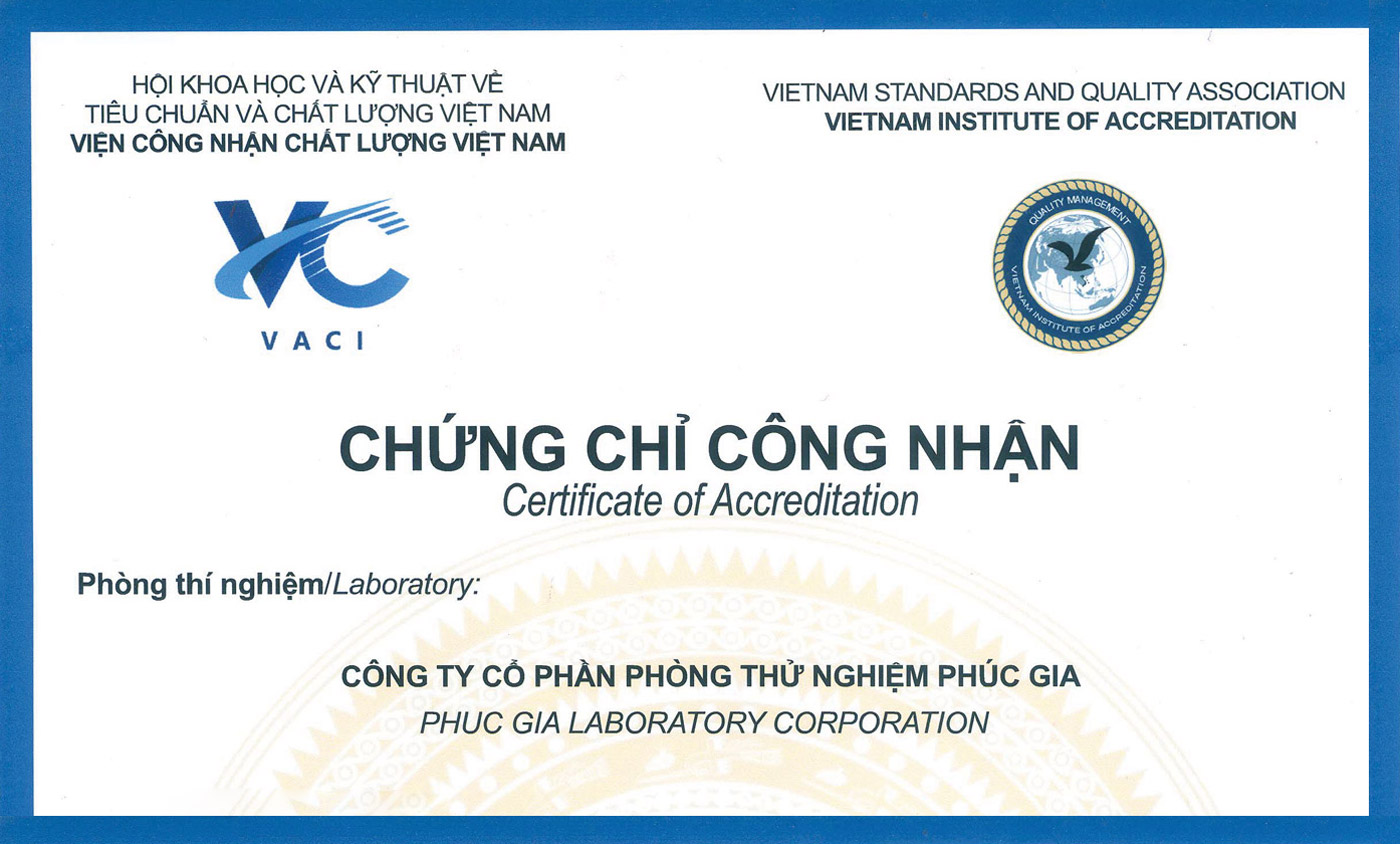
Phuc Gia® currently owns a Testing laboratory meeting ISO/IEC 17025:2017 standards, with high accuracy and reliability for test results. Notably, Phuc Gia® is the first private unit in Vietnam to invest in an Energy Efficiency testing chamber system for air conditioners with a capacity of up to 60,000 Btu/h – the largest capacity level on the market today – using the Enthalpy testing method, helping enterprises best meet requirements for efficiency and Energy labeling registration.
For more details, please contact us at:
PHUC GIA LABORATORY CORPORATION
PHUC GIA CERTIFICATION CENTER
PHUC GIA INSPECTION TESTING CENTER
Address:
- Hanoi: ICD Long Bien, No. 01 Huynh Tan Phat, Sai Dong B Industrial Park, Long Bien Ward
- Ho Chi Minh City: No. 180, D2 Street, Long Truong Ward
Hotline: 0965996696 / 0982996696 / 02477796696
E-mail: lab@phucgia.com.vn/cert@phucgia.com.vn/info@phucgia.com.vn
Website: phucgia.com.vn
Working time: Monday to Friday 8:00 – 18:30; Saturday 8:00 – 12:00

![QUOTATION – Testing and Other Certification Services [2026]](https://phucgia.com.vn/wp-content/uploads/2017/03/bao-gia-thu-nghiem-chung-nhan.png)