

Phuc Gia® is an organization that provides information on SDCM to businesses and organizations. This is a topic that many of Phuc Gia®’s clients are highly interested in; all parties are invited to refer to the article below with Phuc Gia®!
See more: Capacity Profile Of Phuc Gia Laboratory Corporation
What is SDCM?
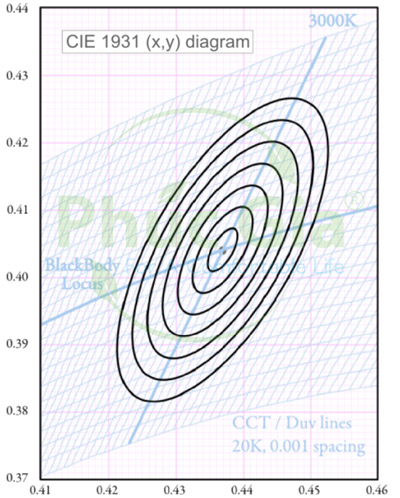
SDCM (Standard Deviation of Color Matching) is used to measure color uniformity (or color consistency). The MacAdam Ellipse is a color measurement system. It measures the degree of color variation that can occur around these axes before the human eye detects the color change. The distance from the target point within each ellipse is measured using SDCM. An SDCM of 1 step means there is virtually no color difference between the LED chips, while 2-3 SDCM means there is almost no visible color difference. A color consistency of 6-7 SDCM is generally market-acceptable and complies with the requirements of the European EcoDesign directive and the US Energy Star requirements.
Color variation is measured by the Standard Deviation of Color Matching (SDCM). A color difference of 1 SDCM unit is invisible, 2 to 4 units are hardly noticeable, and 5 or more units are easily noticeable. The lower the SDCM number, the smaller the color variation.
What is Color Difference?
Color Difference is the measurement of the distance between two color locations in a color space (for example, the difference between the color on a sample and the color on a printed sheet).
Color difference is determined based on the CIE Color Space—specifically, the CIE LAB Model.

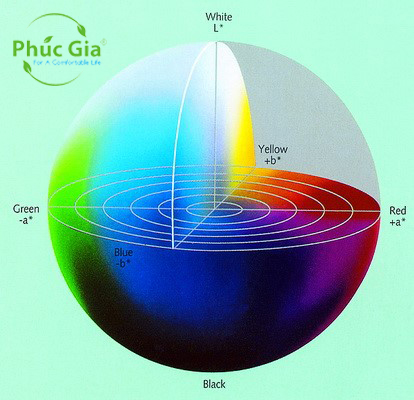
The CIE LAB Model is built upon the color perception ability of the human eye. The LAB values describe all the colors that a person with normal vision can see. LAB is considered a device-independent color model and is often used as a reference basis when converting a color from one color space to another.
According to the LAB model, all colors with the same lightness lie on the same circular plane defined by the two axes, a* and b*. Colors with a positive a* value lean towards red, while those with a negative a* value lean towards green. Similarly, a positive b* leans towards yellow, and a negative b* leans towards blue. The lightness of the color changes along the vertical axis (L*).
Why Are Colors Not Identical?
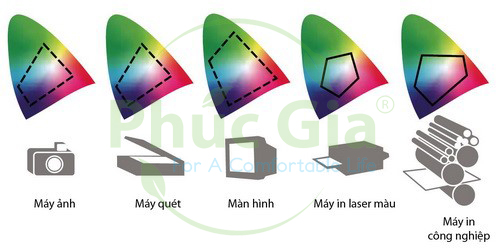
No single device in printing systems is capable of reproducing the entire color spectrum visible to the human eye. Each device operates within a specific, finite color space (gamut). The CIE LAB model has a fixed color space because it is built upon the color perception capability of the human eye, making the LAB model device-independent. The remaining models, such as RGB, CMYK, and HSB, may have various color spaces and are device-dependent.
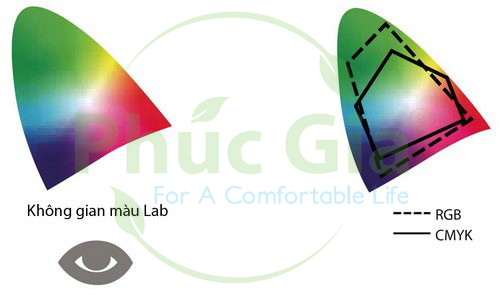
Due to the existence of different color spaces, the color of a document displayed on different devices will not be identical. Color differences can arise because images are created from various sources (from scanners, digital cameras, etc.); graphic software defines colors differently; printing materials vary (newsprint has a narrower color space than coated paper); and because devices are manufactured by different companies; device lifespan varies, etc.
However, the CIE color space has one major drawback: not all colors perceived by the human eye have a corresponding difference in perception at different locations.
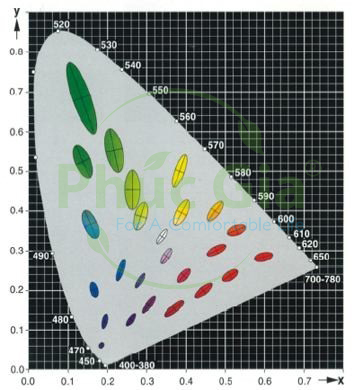
Therefore, MacAdam, an American researcher, studied this phenomenon in a series of experiments. He analyzed and illustrated the results in the following figure. The figure shows the so-called MacAdam ellipses magnified 10 times. Since the CIE color space is a 3D color space, the ellipses are actually ellipsoids (or elliptical volumes). The size of these ellipsoids is a measurement derived from the threshold of perceived color deviation (each ellipsoid is viewed from the center and corresponds to a separate hue).
What is Manufacturing Variation?
The spectral power distribution (and chromaticity point) of an SSL (Solid State Lighting) source is determined by the LEDs, phosphors, and any other materials used to generate the light. During the manufacturing process, there are variations due to the processes used to create the light, which affects the chromaticity point. If these variations are greater than what our eyes can perceive, this will lead to a visually noticeable color mismatch when these sources are installed in a single space. This is why it is necessary to consider the manufacturer’s color point tolerance for the product, which is often specified in terms of SDCM (Standard Deviation of Color Matching) or the MacAdam ellipse. The tighter the variation, the less noticeable the visual mismatch. The figure above provides an example of Xicato’s variation specified as SD2 1×2.
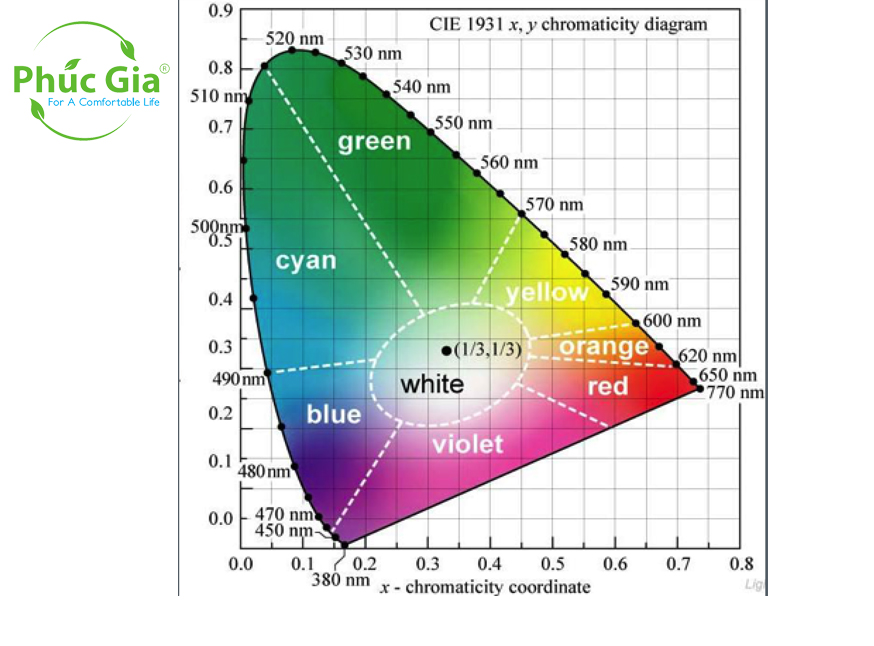
However, this system is not used in practice to estimate the Color Difference (Delta E) because it implies that the acceptable tolerances vary between different hues. To make the calculation of color difference more reliable, a color space is needed where perceptually equal color differences have the same numerical value. CIE LAB and CIE LUV are two systems that possess this advantage. They were developed through mathematical transformation from the CIE color space.
Through this conversion, MacAdam ellipsoids of different sizes are mapped onto spherical volumes of equal size. In this way, the human eye perceives the color difference equally for all colors.
In 1976, the CIE LAB and CIE LUV color spaces—the most commonly used color spaces in the printing industry—were internationally standardized.
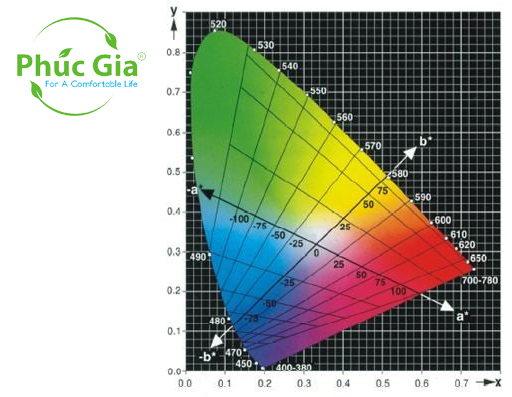
The illustration shows the positions of the a* and b* axes of the CIE LAB color space in the xy color chart. Other color spaces such as the CMC system and the Munsell color space are also used in the United States.
CIE LAB Color Space
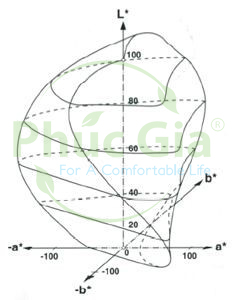
The CIE LAB color space is most frequently used for measuring the color of physical objects (such as printing ink), for example, to mix an ink formula or to check print quality. Hues and color saturation are plotted on the a* and b* axes.
The a* axis runs from -a* (Green) to +a* (Red), and the b* axis runs from -b* (Blue) to +b* (Yellow).
The Lightness axis L* has values from 0 (black at the bottom) to 100 (white at the top).
The illustration above shows the CIE LAB color space used for measuring the color of objects. Because it is the result of a transformation process, its shape differs from the CIE color space. Similarly, the shape of each lightness value changes with L*.
In the illustration, the cross-section of the CIE LAB color space shows object colors at a lightness value of L*=50. The green color area is narrowed, and the blue color area is clearly visible. This map is very essential for practical users.
An L* = 75.3 value signifies a bright color that is located between, and a flag red color has values of a*=51.2 and b*=48.4. Therefore, one can deduce that this is a bright orange color.
Conclusion:
The reference color and the measured color have different locations in the color space, meaning their colors are different.
What is a Reference Color?
It is the color selected to serve as the standard or the color that needs to be reproduced.
The above is Phuc Gia®’s analysis of SDCM that we wish to share with organizations. In addition to providing information on SDCM, Phuc Gia® is also a leading provider of Logistics Services, Certification and Conformity Declaration Services, Energy Labeling Services, Food Safety Declaration Services, and especially Testing – Certification Services. Organizations in need should contact Phuc Gia® immediately to receive in-depth consultation and comprehensive Customs Services (from A–Z) in the quickest and most professional manner!
WHAT MAKES THE PHUC GIA® BRAND:
Phuc Gia® – The Leading Unit Providing Customs Services:
The reasons why all enterprises choose Phuc Gia® as the leading unit in consulting for Food Safety Conformity Declaration and Food Safety Regulatory Compliance Declaration, Energy Labeling, Conformity Certification, Cosmetic Declaration, and Logistics Services:
Phuc Gia® has over 10 years of experience in the industry, and is the first unit with sufficient capability to provide Customs services to over 500 large and small organizations In & Out of Vietnam, including: Sharp (2012); Samsung (2012); Hitachi (2013); Electrolux (2013); Panasonic (2013); LG (2013); Sony (2013); Siemens (2013); Mitsubishi (2013); GE (2013); Haier (2014); Toshiba (2014); Carrier (2014); Philips (2014); HappyCook (2015); General (2015); TCL (2015); Alaska (2015); Casper (2015); Gree (2016); Hải Hà (2016); VinMart (2017)…
Phuc Gia® owns a professional Consultation Team and workflow process, capable of answering all enterprise inquiries, helping customers optimize time, mental effort, physical effort, and minimize risks during the process of goods transportation and customs clearance procedures.
Phuc Gia® is the first & only unit to publicly announce the Global Listed Price on its Website and provide free one-year insurance to customers in the event that State legal regulations change!
FREQUENTLY ASKED QUESTIONS:
Despite our services being in the high-price segment, why is Phuc Gia® still chosen by enterprises as the leading reliable unit for customs services?
- This is a concern shared by many customers before choosing Phuc Gia® as their Customs Services provider.
- Over the past 10 years, Phuc Gia® has served over 500 large and small Domestic and International Enterprises. More than 90% of the enterprises that have used Phuc Gia®’s Customs Services agree that the quality of the Service is commensurate with the money they invest.
- Customers comment that: “The price the Enterprise pays when using Phuc Gia®’s Customs Services is SIGNIFICANTLY MORE COST-EFFECTIVE compared to the time and expense the Enterprise would incur to independently complete tasks such as: self-arranging product testing; self-researching and preparing dossiers; self-working with relevant ministries and departments to finalize dossiers; self-obtaining Customs Clearance permits…”
- Phuc Gia® commits to optimizing your time, mental effort, physical effort, and money during the Customs Clearance process, as well as MINIMIZING RISKS during the licensing process!
For more details, please contact us at:
PHUC GIA LABORATORY CORPORATION
PHUC GIA CERTIFICATION CENTER
PHUC GIA INSPECTION TESTING CENTER
Address: ICD Long Bien, No. 01 Huynh Tan Phat, Sai Dong B Industrial Park, Long Bien Ward, Hanoi City, Vietnam.
Hotline: 0981 996 996/ 0982 996 696/ 024 7779 6696
E-mail: lab@phucgia.com.vn
Website: phucgia.com.vn
Working time: Monday to Friday 8:00 – 18:30; Saturday 8:00 – 12:00

![QUOTATION – Testing and Other Certification Services [2026]](https://phucgia.com.vn/wp-content/uploads/2017/03/bao-gia-thu-nghiem-chung-nhan.png)