

Phuc Gia® is an organization that provides information about light measurement quantities (photometric quantities) to individuals, organizations, and enterprises both domestically and internationally. This information is directly relevant to businesses. Therefore, please refer to the article below as Phuc Gia® will clarify these issues.
See more: Capacity Profile Of Phuc Gia Laboratory Corporation
Luminous Intensity
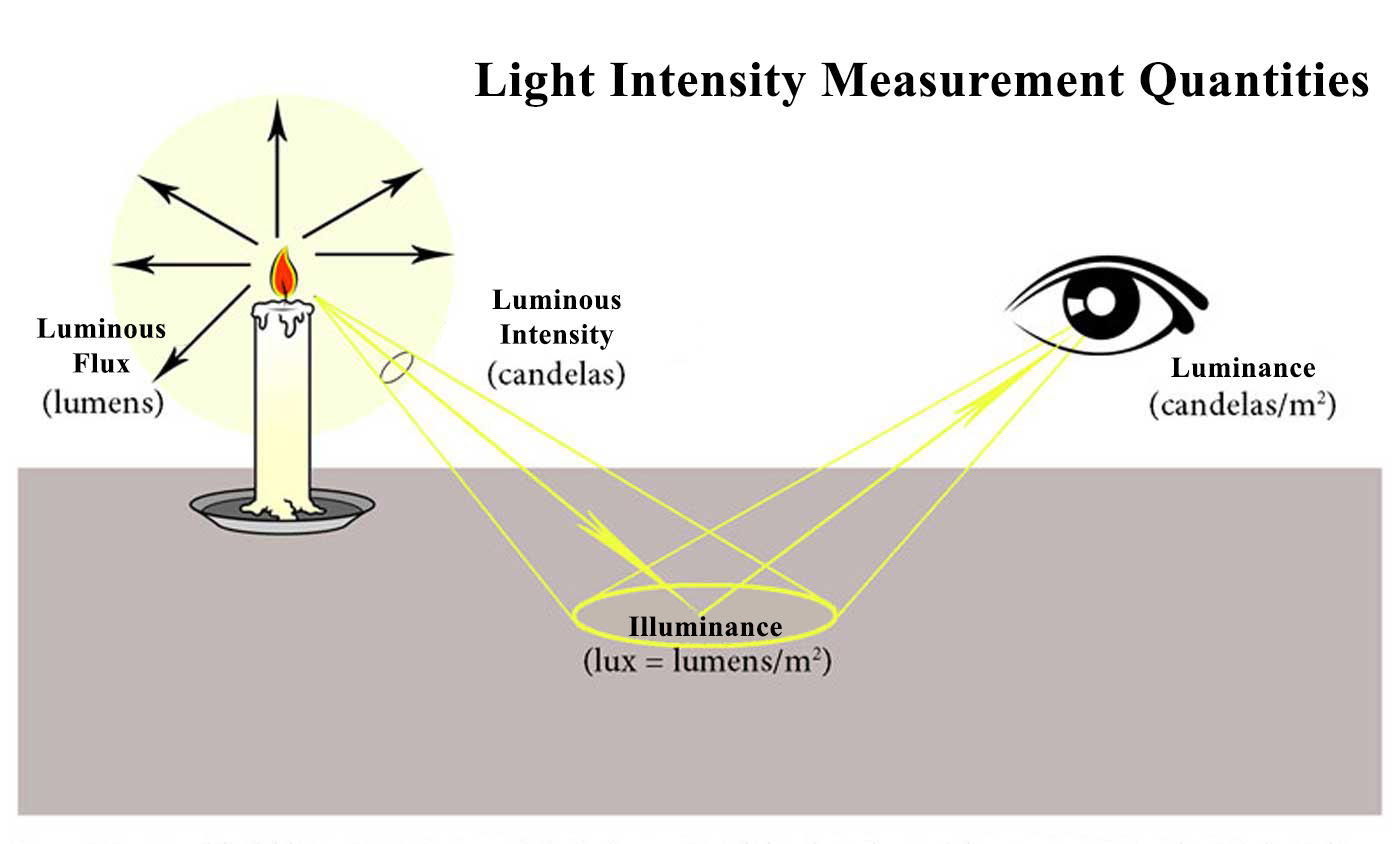
Luminous Intensity is a fundamental optical quantity used in measuring light source parameters; it is one of the seven basic units of the International System of Units (SI): m (meter), kg (kilogram), s (second), A (Ampere), K (Kelvin), mol (mole), and cd (candela). The concept of luminous intensity expresses the density of energy emitted from a light source in a specific direction, or it can be defined as the luminous flux in a given direction emitted per unit solid angle (1cd = 1 lumen/steradian). Since October 1979, the CIE (International Commission on Illumination) has introduced a new definition for the candela: “The candela is the luminous intensity, in a given direction, of a source that emits monochromatic radiation of wavelength = 555nm and that has a radiant intensity in that direction of 1/683 w/steradian.”
The unit of luminous intensity is the candela (cd), with the word candela meaning “candle” in Latin. A typical candle emits light with a luminous intensity of approximately one candela. If emission in certain directions is blocked by an opaque barrier, the light source still maintains an intensity of about one candela in the unblocked directions.
To represent the distribution of luminous intensity in space, a polar coordinate system is often used, where the origin is the light source and the endpoints are the luminous intensity vectors. In practice, this diagram is represented in a plane or semi-plane by drawing the curve resulting from the intersection of this surface with certain defined meridian planes. For light sources with circular symmetry (rotationally symmetric), only one cut by a meridian plane is sufficient. Luminous intensity measurements must be performed in specialized measuring chambers using a device called a goniophotometer.
| Table of Luminous Intensity for Selected Light Sources | |
| Light Source | Luminous Intensity (cd) |
| Candle Flame | 0.8cd in all directions |
| 40W Incandescent Lamp | 35cd in all directions |
| Metal Halide Lamp with Reflector | 14.800cd in all directions, 250.000cd at the center of the beam |
Luminous Flux
Luminous Flux is the photometric quantity that indicates the radiant power of the light beam emitted from a light source, or, alternatively, luminous flux is the flow of light emitted from a light source in all directions over one second. The unit of measurement for luminous flux is the lumen (lm). To measure the luminous flux of a common artificial light source, a specialized measuring device called a Photometer or Integrating Sphere is typically used.
| Table of Luminous Flux for Selected Common Light Sources | |
| Light Source | Luminous Flux (lm) |
| 250W High-Pressure Sodium Lamp | 27.000 lm |
| 400W High-Pressure Sodium Lamp | 47.000 lm |
| Chipleds Cree XT-E LEDs Ra > 70 CCT ~ 4000K | 168lm @(Tj=85°C, IF=350mA, VF=2,85V) |
| Chipleds Philips Luxeon 3030/2D Ra > 70 CCT ~ 4000K | 99lm @(Tj=25°C, IF=100mA) |
Luminance
To characterize the ability of a light source or a reflective surface to emit light that causes the sensation of glare to the eye, the definition of Luminance is introduced. Luminance is a quantity that determines the luminous intensity emitted per unit area of a surface in a specific direction. It estimates the light that the human eye can perceive and depends on the direction of observation. Luminance plays a fundamental role in lighting engineering, serving as the basis for concepts related to perception and visual comfort. The unit of measurement for luminance is candela per square meter (cd/m²).
| Table of Luminance for Selected Common Light Sources | |
| Light Source | Luminance (cd/m²) |
| Surface of the Sun | 165.107 cd/m² |
| Surface of the Moon | 1500 cd/m² |
| Blue Sky | 1500 cd/m² |
| Overcast Sky | 1000 cd/m² |
| White Paper at an Illuminance of 400 lux | 80 cd/m² |
| Roadway Surface at 30 lux Illuminance | 1,2 ~ 2 cd/m² |
Illuminance
Illuminance (E) is the quantity characterizing an illuminated surface, representing the density of luminous flux over a surface with area (S). The unit of illuminance is Lux (Lx), where one lux is the luminous flux density of a light source of 1 lumen over an area of 1 m² (1 lux = 1 lm/m²). When the illuminated surface is non-uniform, the illuminance is calculated as the arithmetic mean of the illuminance at various points.
The concept of illuminance, besides the light source, is also related to the position of the illuminated surface. When considering the light source as a point (O) with luminous intensity I radiating onto an elemental surface (dS) at a distance (R) from (O), the illuminance on the elemental surface (dS) will change with the relative inclination of the surface (the angle between the normal to (dS) and the direction (R)) and is inversely proportional to the square of the distance (R).
| Table of Illuminance on Some Commonly Encountered Surfaces | |
| Illuminated Location | Illuminance (lux) |
| Outdoors at Noon, Sunny | 100.000 lux |
| Outdoors at Noon, Overcast/Cloudy | 10.000 lux |
| Workspace | 300 ~ 500 lux |
| Street Illuminated at Night | 20 ~ 50 lux |
Correlated Color Temperature (CCT)
The correlated color temperature of a light source, expressed on the Kelvin (K) scale, is the expression of the color of the light it emits. Imagine an iron bar: when cool, it is black; when heated steadily, it glows orange; continued heating turns it yellow; and continued heating until it becomes “white hot.” At any point during this heating process, we can measure the temperature of the steel bar in degrees Kelvin (0ºC corresponds to 273.15 K) and assign that value to the color produced.
For incandescent lamps, the color temperature is precisely the physical temperature of the filament itself. For fluorescent lamps, discharge lamps (generally, all non-incandescent lights), the color temperature is only representative, determined by comparing it to the equivalent temperature of a heated black body radiator. When speaking of a lamp’s color temperature, one immediately gets the feeling of whether the light source is “warm,” “neutral,” or “cool.” Generally, the lower the temperature, the warmer the source, and conversely, the higher the temperature, the cooler the source.
| Table of Color Temperature for Selected Light Sources | |
| Light Source | Color Temperature (K) |
| Blue Sky | 10.000K ~ 30.000K |
| Overcast Sky Light | 6000K ~ 8000K |
| Daylight Fluorescent Lamp | 6200K |
| Warm White Fluorescent Lamp | 3000K |
| High-Pressure Metal Halide Lamp | 4100K |
| Incandescent Lamp | 2500K |
| Candle Flame | 1800K |
Color Rendering Index (CRI or Ra)
The Color Rendering Index (also referred to as: Color Rendition, Color Rendering Quality, or Color Rendering Index) is a quantity that indicates the ability of an artificial light source compared to an ideal or natural light source when assessing the color fidelity of an illuminated object. Light sources with high CRI are desirable in color-critical applications, such as vanity desks, fashion shops, infant care, and art restoration, where the highest possible CRI should be used.
The Color Rendering Index is symbolized as CRI (or Ra). The highest CRI value is 100. CRI = 100 is the color rendering index of a standardized light source whose light is identical to daylight. The CRI of other light sources will be less than 100, for example, a Halogen incandescent bulb has CRI ~ 100, a fluorescent lamp has CRI ~ 50, an LED lamp has CRI > 70, and the CRI of a low-pressure sodium lamp is a negative value.
The concept of the CRI was first introduced in 1964. Essentially, the index is measured as a reference result based on the appearance of eight color patches when illuminated by a test source, compared to the same color patches displayed under a standard light source (CRI = 100). However, this evaluation method does not fully account for the saturation of the light source. This means that if one or two colors render poorly while all other colors render very well, the CRI index is not penalized heavily and still achieves a high value. Therefore, in 2005, the CIE (International Commission on Illumination) introduced a new concept to address the inadequacy of CRI, and this new index is called the Color Quality Scale (CQS).
The Color Quality Scale (CQS) is a quantitative measure of a light source’s ability to accurately reproduce the colors of objects illuminated by that source. Similar to CRI, the highest value of CQS is 100; however, CQS does not have negative values, so the CQS scale ranges from 0 to 100. CQS is designed such that its score is reduced if one or two colors appear poorly, even if all other colors are rendered well, and it assigns a score of 0 to light sources that are virtually monochromatic (such as low-pressure sodium lamps).
Luminous Efficacy
Luminous Efficacy (or often simply called luminous efficiency) fully expresses the ability of a light source to convert consumed energy into luminous energy. Luminous efficacy is the ratio between the luminous flux emitted by the light source and the electrical power consumed by the light source, meaning how many lumens are produced per watt of electricity. The unit of measurement for luminous efficacy is lm/W.
In practical application, the light source (lamp) rarely operates independently; it must be accompanied by the entire luminaire system. Most light sources require the installation of additional electrical components to operate. For a luminaire designed to meet specific lighting requirements, besides the losses from these associated electrical components, there are also luminous flux losses due to the optical chamber structure, heat dissipation issues, etc., of the luminaire itself. Therefore, it is necessary to clearly distinguish between the luminous efficacy of the light source and the luminous efficacy of the entire luminaire.
Typically, light source manufacturers only publish the luminous efficacy of the light source measured under standard conditions, without accounting for the losses from associated electrical components. Luminaire manufacturers, depending on the type of luminaire, may publish the luminous efficacy of the light source, the luminous efficacy of the entire luminaire, or both simultaneously.
WHAT MAKES THE PHUC GIA® BRAND:
Phuc Gia® – The Leading Unit Providing Customs Services:
The reasons why all enterprises choose Phuc Gia® as the leading unit in consulting for Food Safety Conformity Declaration and Food Safety Regulatory Compliance Declaration, Energy Labeling, Conformity Certification, Cosmetic Declaration, and Logistics Services:
Phuc Gia® has over 10 years of experience in the industry, and is the first unit with sufficient capability to provide Customs services to over 500 large and small organizations In & Out of Vietnam, including: Sharp (2012); Samsung (2012); Hitachi (2013); Electrolux (2013); Panasonic (2013); LG (2013); Sony (2013); Siemens (2013); Mitsubishi (2013); GE (2013); Haier (2014); Toshiba (2014); Carrier (2014); Philips (2014); HappyCook (2015); General (2015); TCL (2015); Alaska (2015); Casper (2015); Gree (2016); Hải Hà (2016); VinMart (2017)…
Phuc Gia® owns a professional Consultation Team and workflow process, capable of answering all enterprise inquiries, helping customers optimize time, mental effort, physical effort, and minimize risks during the process of goods transportation and customs clearance procedures.
Phuc Gia® is the first & only unit to publicly announce the Global Listed Price on its Website and provide free one-year insurance to customers in the event that State legal regulations change!
FREQUENTLY ASKED QUESTIONS:
Despite our services being in the high-price segment, why is Phuc Gia® still chosen by enterprises as the leading reliable unit for customs services?
- This is a concern shared by many customers before choosing Phuc Gia® as their Customs Services provider.
- Over the past 10 years, Phuc Gia® has served over 500 large and small Domestic and International Enterprises. More than 90% of the enterprises that have used Phuc Gia®’s Customs Services agree that the quality of the Service is commensurate with the money they invest.
- Customers comment that: “The price the Enterprise pays when using Phuc Gia®’s Customs Services is SIGNIFICANTLY MORE COST-EFFECTIVE compared to the time and expense the Enterprise would incur to independently complete tasks such as: self-arranging product testing; self-researching and preparing dossiers; self-working with relevant ministries and departments to finalize dossiers; self-obtaining Customs Clearance permits…”
- Phuc Gia® commits to optimizing your time, mental effort, physical effort, and money during the Customs Clearance process, as well as MINIMIZING RISKS during the licensing process!
For more details, please contact us at:
PHUC GIA LABORATORY CORPORATION
PHUC GIA CERTIFICATION CENTER
PHUC GIA INSPECTION TESTING CENTER
Address: ICD Long Bien, No. 01 Huynh Tan Phat, Sai Dong B Industrial Park, Long Bien Ward, Hanoi City, Vietnam.
Hotline: 0981 996 996/ 0982 996 696/ 024 7779 6696
E-mail: lab@phucgia.com.vn
Website: phucgia.com.vn
Working time: Monday to Friday 8:00 – 18:30; Saturday 8:00 – 12:00

![QUOTATION – Testing and Other Certification Services [2026]](https://phucgia.com.vn/wp-content/uploads/2017/03/bao-gia-thu-nghiem-chung-nhan.png)